Decor & Styling
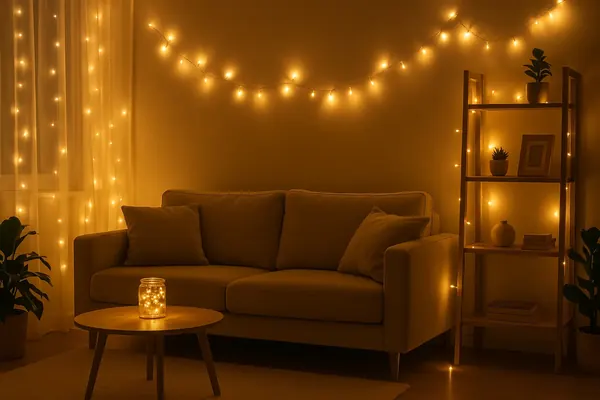
Fairy Lights Living Room Ideas That Look Grown-Up
Ten grown-up ways to use fairy lights in a living room, plus how to choose warm lights, hide the wires, hang them without damage and keep them safe.
Free design tool
Choose your room type and enter its size, and this room lighting calculator works out how many lumens you need, how many standard LED bulbs that equals, and how to split the light into ambient, task, and accent layers. It also suggests the right color temperature for the room.
Results are planning guidelines based on standard interior design rules of thumb. Always measure twice and check product dimensions before you buy.
The calculator uses one simple formula: lumens = room square footage × foot-candle target. A foot-candle is one lumen spread across one square foot, so multiplying area by the target brightness gives the total light output your fixtures should produce. Different rooms need different targets because the activities in them differ: you need far more light to shave or chop vegetables than to watch a movie.
Once it has a lumen total, the tool divides by 800 lumens, the output of a standard 60-watt-equivalent LED bulb, and rounds up to give a bulb count. It then splits that light into layers so you know how much should come from ceiling fixtures, lamps, and accent lights.
| Room | Foot-candles | Lumens per 100 sq ft | Color temperature |
|---|---|---|---|
| Living room | 10–20 | 1,000–2,000 | 2700K |
| Bedroom | 10–20 | 1,000–2,000 | 2700K |
| Dining room | 30–40 | 3,000–4,000 | 2700K |
| Kitchen | 30–40 (task areas higher) | 3,000–4,000 | 3000K |
| Bathroom | 70–80 | 7,000–8,000 | 3000K |
| Home office | 30–50 | 3,000–5,000 | 3500–4000K |
| Hallway or entry | 5–10 | 500–1,000 | 2700K |
Example: a 12 by 15 foot living room is 180 square feet. At 10 to 20 foot-candles, it needs 1,800 to 3,600 lumens. At the top of that range, 3,600 ÷ 800 = 4.5, so plan on about five 800-lumen bulbs spread across the room.
A single overhead fixture providing all the light is what makes many apartments feel flat and institutional. The calculator divides your total into three layers, starting from about 50 percent ambient, 30 percent task, and 20 percent accent.
Task light should sit close to where you need it: a reading lamp's shade bottom roughly at shoulder height when you are seated, or under-cabinet strips toward the front edge of the cabinet so light falls on the counter rather than the backsplash. In kitchens and bathrooms, task areas need more light than the room average, so the calculator's task share matters most there.
In a 3,600-lumen living room, that works out to roughly 1,800 lumens of ambient, 1,080 of task, and 720 of accent light.
Color temperature, measured in kelvins (K), describes how warm or cool white light looks. Lower numbers are warmer and more golden; higher numbers are cooler and bluer.
Keep color temperature consistent within a room. Mixing 2700K lamps with a 5000K ceiling light makes both look wrong. Look for bulbs with a high color rendering index (CRI 90 or above) so fabrics, wood, and skin tones look natural.
Designer tip: Put as many lights as possible on dimmers. Sizing for the top of the lumen range and then dimming down gives you bright light for cleaning and a warm, low glow for evenings. Plug-in dimmers and smart bulbs work in rentals with no rewiring.
Most apartments come with a single builder-grade ceiling fixture, and many have none in the living room at all. You can still hit your lumen targets with plug-in pieces:
Good lighting is one of the fastest ways to change how a room feels. For more ideas, see our apartment living room ideas, our list of renter friendly upgrades, and our guide on how to make your apartment look expensive.
Multiply the room's square footage by its recommended foot-candle level. Living rooms and bedrooms need about 10 to 20 foot-candles, kitchens and dining rooms 30 to 40, home offices 30 to 50, and bathrooms 70 to 80. A 150 square foot bedroom therefore needs roughly 1,500 to 3,000 lumens in total, spread across several light sources rather than a single ceiling fixture.
A foot-candle is a unit of illuminance: the amount of light landing on a surface, equal to one lumen spread over one square foot. Lighting designers use foot-candle targets to set how bright a room should be for its activities. Because one foot-candle equals one lumen per square foot, multiplying square footage by the target gives total lumens.
A 60-watt incandescent equivalent LED produces about 800 lumens while drawing only around 8 to 10 watts. That is why this calculator counts bulbs in 800-lumen units. A 40-watt equivalent gives about 450 lumens, a 75-watt equivalent about 1,100, and a 100-watt equivalent about 1,600. Always shop by lumens on the package rather than watts.
Warm white around 2700K is best for living rooms and bedrooms because it mimics the cozy glow of incandescent light and flatters skin and wood tones. Use about 3000K in kitchens and bathrooms for a clean but still warm light, and 3500 to 4000K in a home office where you want crisp, alert lighting for focused work.
Layered lighting combines three types of light: ambient for overall illumination, task for activities like reading and cooking, and accent for highlighting art, plants, or architecture. A good starting split is about 50 percent ambient, 30 percent task, and 20 percent accent. Layers let you change the mood of a room, especially when each layer is on a dimmer.
Ten grown-up ways to use fairy lights in a living room, plus how to choose warm lights, hide the wires, hang them without damage and keep them safe.
Layouts, clearances, rug sizes, lighting and renter-friendly decor to make an apartment living room of any size feel calm, finished and high-end.
Curtains hung high, warm layered light, bigger rugs and fewer, better objects: the designer moves that make any apartment look luxurious without a big budget.