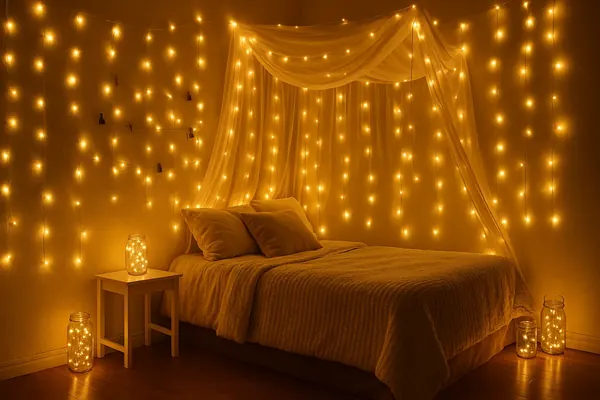
Fairy Lights in the Living Room: Elegant Ideas, Renter-Safe Hanging and Safety Tips
Ten grown-up ways to use fairy lights in a living room, plus how to choose warm lights, hide the wires, hang them without damage and keep them safe.
Key takeaways
- Choose warm white fairy lights at 2200 to 2700K and avoid flashing modes.
- Copper or brass micro-wire strings almost disappear, so you see the glow rather than the wire.
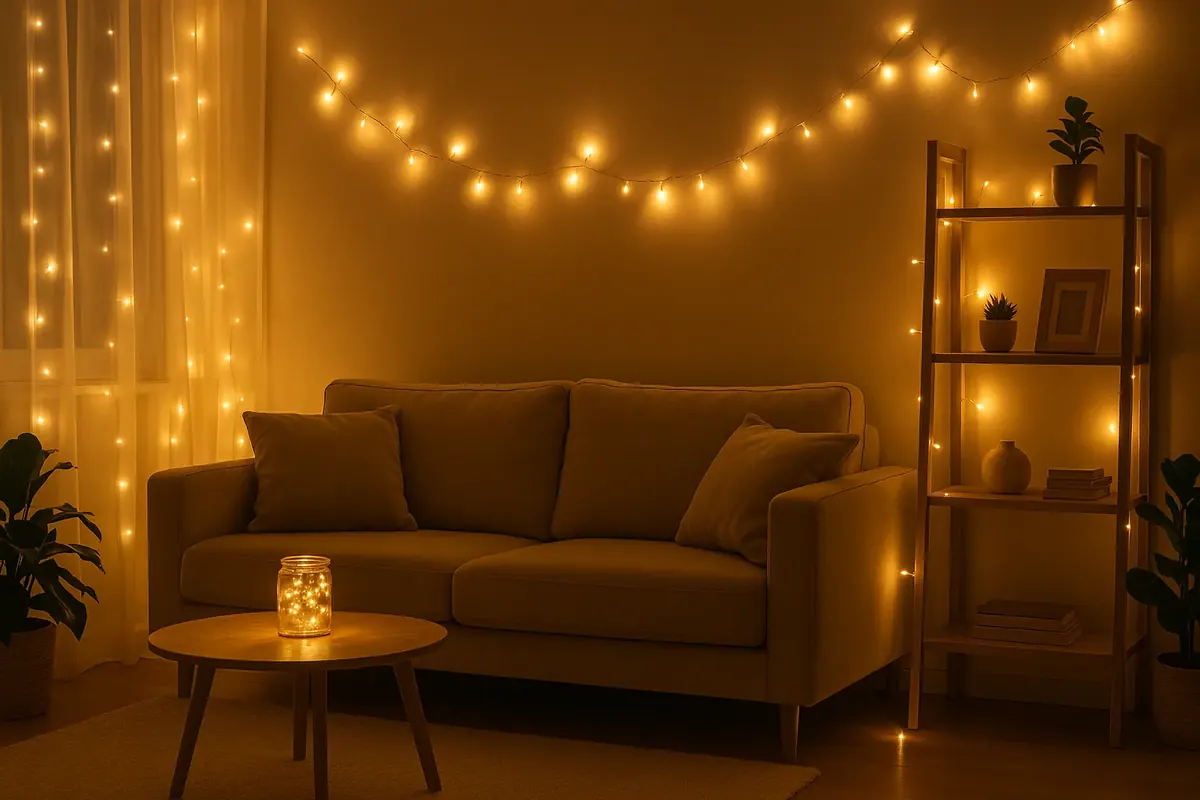
- Light shelves, mirrors, sheer curtains, glass vessels and branches instead of covering bare walls.
- Use removable adhesive clips, tension rods and curtain rods to hang lights without wall damage.
- Put lights on a dimmer and timer, use LEDs only and never run cords under rugs.
Fairy lights in a living room can look either like a dorm room or like a boutique hotel bar. The difference is rarely the lights themselves. It's color temperature, where the wire goes and how bright they are. Choose a warm 2200–2700K glow, hide the cord runs, put everything on a dimmer and use the lights to highlight things you already love, such as shelves, a mirror, plants or a window. Do that and string lights become a quiet layer of ambient light rather than a decoration.
This guide covers the grown-up approach: which lights to buy, ten fairy light ideas for the living room that look intentional, how to hang fairy lights without damaging walls (essential for renters), and the safety points to check before you leave them on for an evening.
Think of fairy lights as the accent layer in a lighting plan. They work alongside lamps and overhead light, not in place of them.
Choosing Fairy Lights That Look Elevated
Most of the "cheap" look comes from cool white LEDs, visible plastic wire and fast-flashing modes. Avoid those and you're already most of the way there.
Color temperature
Look for "warm white" or "extra warm" and check the Kelvin rating when it's listed. 2200–2400K gives a candlelight glow that suits evenings and moody rooms; 2700K matches standard warm lamps, so the string lights blend in with the rest of your lighting. Anything above 3000K starts to look clinical next to warm lamps.
Wire and bulb type
| Type | Look | Best living room use |
|---|---|---|
| Copper or brass micro-wire | Nearly invisible wire, tiny points of light | Shelves, vases, mirrors, plants |
| Clear or black PVC cable, mini LEDs | Sturdier, more visible wire | Long runs along ceilings or behind furniture |
| Café / festoon (bulbs on a cord) | Larger round or Edison-style bulbs | Statement swags across a wide wall or high ceiling |
| Curtain lights (vertical drops) | Sheet of light strands | Behind sheer curtains or a room divider |
| Cluster / garland lights | Dense, rope-like glow | Mantels, top of a bookcase, along a beam |
Power source
Plug-in lights give steady brightness and work with plug-in dimmers or smart plugs, which makes them the better choice for anything you use daily. Battery or USB lights are handy for spots without an outlet, such as a vase, a lantern or the top of a tall cabinet. Choose ones with a built-in timer so they turn off automatically.
Designer tip: Skip the flashing modes. A steady glow on a dimmer reads as lighting; twinkling reads as a party decoration. If your lights have a controller, set them to "steady on" and leave them there.
How Many Fairy Lights Do You Need?
For decorative runs, a useful rule is to measure the path you want to light and add 20–30 percent for drape, wrapping and reaching the outlet. For wrapping objects like branches or a plant, plan on roughly 3x the height of the object.
- Bookcase, 6 ft tall, 3 ft wide: about 33–50 ft (10–15 m) if you light each shelf front edge.
- Window frame, 4 x 5 ft: about 18–25 ft (5.5–7.5 m).
- Ceiling perimeter of a 12 x 14 ft room: about 52 ft plus slack, so 60–65 ft (18–20 m).
- Floor-standing branch or olive tree, 5 ft: about 15–20 ft (4.5–6 m).
Fairy lights contribute only a small amount of usable light; a 30–50 ft micro-LED string typically gives far less than a single table lamp. Use the room lighting calculator to plan your lamps and overhead light first, then add string lights for atmosphere.
10 Fairy Light Ideas for a Living Room That Look Grown-Up
1. Backlit bookshelves
Run micro-wire lights along the underside of each shelf front edge or tuck them behind the books toward the back. The light grazes the spines and objects without showing a single bulb. This is the most elegant use of string lights in a living room.
2. A mirror halo
Thread a copper string behind the edges of a large leaning or hung mirror so the light spills out around it. The glow doubles in the reflection, which makes a small room feel brighter.
3. Inside glass
Coil battery micro-lights inside a large glass cloche, hurricane lantern or clear vase on a console or coffee table. Group two or three vessels of different heights for a soft, candle-like centerpiece without open flame.
4. Branches in a tall vase
Wrap dried or faux branches (curly willow, olive, birch) with micro-wire lights and stand them in a heavy floor vase in a corner. It fills an awkward empty corner and gives height.
5. Behind sheer curtains
Hang curtain lights or a few vertical strands on the window side of sheer curtains. In the evening the fabric diffuses the light into a soft wall of glow, and during the day you don't see it at all.
6. A hidden ceiling cove effect
Run a string along the top of crown molding, a curtain pelmet or the top edge of tall cabinets so the light washes upward onto the ceiling. You see the glow, not the source, which mimics architectural cove lighting.
7. Behind the sofa or media console
Tuck a string along the back of the media console or the back of a floating sofa, aimed at the wall. It's a gentle bias light for TV watching and makes furniture look like it's floating.
8. Along a mantel or beam
Weave cluster lights through a eucalyptus or olive garland on a mantel, picture ledge or exposed beam. Keep the greenery full so the wire disappears into it.
9. Around large plants
Loosely wrap the trunk and inner branches of a fiddle-leaf fig, olive tree or tall palm. Keep the lights to the interior so the leaves soften the points of light. Use LEDs only, which stay cool, and check the plant periodically.
10. A café-light swag in a lofty room
If you have a high ceiling or a long open-plan room, hang one or two shallow swags of festoon bulbs across the space. Keep the drop to 6–12 in. per span so it looks deliberate, and keep at least 7 ft of headroom below the lowest point.
The best fairy light setups show you the glow, not the wire.
How to Hang Fairy Lights Without Damaging Walls
Most living room ideas above need little or no wall contact. When you do need to fix a run to a wall or ceiling, these methods are renter-friendly.
| Method | Holds | Best for | Removal |
|---|---|---|---|
| Clear adhesive hooks (small, removable strips) | Micro-wire and light strings | Painted drywall, ceiling perimeter | Pull tab straight down slowly |
| Adhesive cable clips | Single wire runs | Baseboards, behind furniture, shelf undersides | Peel slowly; warm with a hair dryer first |
| Washi or painter's tape | Very light copper wire | Short-term, shelf edges | Peel at a low angle |
| Tension rod | Curtain lights, short swags | Inside window frames, alcoves | No marks |
| Over-the-curtain-rod draping or clips | Any string | Windows | No marks |
| Small brass push pins | Light strings | Areas where a tiny hole is acceptable | Fill with spackle |
Step-by-step: a clean, renter-safe run
- Plan the route from the outlet first so the plug and controller end up hidden behind furniture.
- Wipe the wall where adhesives will go with rubbing alcohol and let it dry; dust and grease cause most failures.
- Press each adhesive clip firmly for 30 seconds and wait the recommended time (often an hour) before loading it.
- Space clips every 12–18 in. on straight runs and at every change of direction.
- Run the cord down a corner or behind a curtain to the outlet, using a paintable cord cover where it would show.
- Plug into a dimmer or smart plug, set the brightness, and set a schedule so the lights turn off on their own.
Renter note: Even "damage-free" adhesives can lift fresh or flat paint, especially on cheaper builder paint. Test one clip somewhere hidden for a week before committing. Remove adhesives by pulling the tab slowly downward, parallel to the wall, never outward.
Dimmers, Timers and Smart Control
A dimmer is what turns fairy lights from decorative to atmospheric. Many plug-in strings come with a controller that dims, but a plug-in dimmer or smart plug gives you more control and lets you group lights with your lamps.
- Plug-in rotary or inline dimmers: inexpensive and simple. Check that they're rated for LED loads.
- Smart plugs: schedule lights to come on at sunset and off at bedtime; most can't dim but can switch.
- Smart light strings: app-controlled brightness and warmth. Choose models that let you lock to a warm white.
Aim for fairy lights to sit at about 20–40 percent brightness in the evening while lamps provide the main light. That balance is what gives a room depth.
Fairy Light Safety Tips
LED fairy lights run cool and use little power, but they still need sensible handling.
- Buy lights listed by a recognized testing lab (look for a UL or ETL mark in the US) and use indoor lights indoors.
- Choose LED, not incandescent mini lights, for anything near fabric, paper, dried branches or plants.
- Don't run cords under rugs, where they can overheat or get damaged, or pinch them under furniture legs.
- Don't link more strings end to end than the packaging allows.
- Keep battery packs where you can reach them and remove batteries from strings you're storing.
- Unplug or switch off at bedtime or when you leave home; a timer makes this automatic.
- Check for frayed wires, cracked bulbs or warm plugs before each season and replace damaged strings.
Fairy Lights Living Room: Typical Costs
Typical US price ranges at mainstream retailers:
- Battery micro-wire strings (10–20 ft): $5–$15 each
- Plug-in micro-LED strings (33–66 ft): $12–$30
- Curtain lights: $15–$35
- Indoor festoon / café lights (25–50 ft): $25–$70
- Smart plug or plug-in dimmer: $10–$25
- Removable adhesive clips and hooks: $5–$15 per pack
A complete, well-hidden setup for one living room, with two or three ideas from the list above, typically comes in between $40 and $120.
Putting It All Together
Treat fairy lights as part of your lighting plan rather than as decoration. Pick one or two of the ideas above, use warm 2200–2700K micro-wire lights, hide every cord, and put the setup on a dimmer and timer. Then balance it against warm lamps so the room glows rather than sparkles.
For the bigger picture, see our apartment living room ideas for layout and layered lighting, and fairy lights in the bedroom for headboard and canopy projects. If you're making several small updates at once, our renter friendly upgrades guide has more deposit-safe changes.
Free interactive tool
Room Lighting Calculator: lumens and a layered lighting plan
Frequently Asked Questions
How do you hang fairy lights in a living room without damaging walls?
Use small removable adhesive hooks or cable clips on clean, dry walls, spaced every 12 to 18 inches. Drape lights over curtain rods, use tension rods in window frames, or tuck them along shelves and behind furniture so they need no wall contact at all. Test adhesives in a hidden spot first and remove them by pulling the tab slowly down.
How do you make fairy lights look classy?
Choose warm white lights around 2200 to 2700K, use thin copper or brass wire, and turn off any flashing modes. Hide the plug and cord, and use the lights to highlight shelves, mirrors, plants or sheer curtains rather than spelling out shapes on a bare wall. Dimming them to a low glow alongside warm lamps makes them look intentional.
Where should I put fairy lights in my living room?
Good spots include under or behind bookshelf edges, around a large mirror, inside glass vases or lanterns, wrapped through branches in a tall floor vase, behind sheer curtains, along a mantel garland and along the top of cabinets or molding so the light washes the ceiling.
Is it safe to leave fairy lights on all night?
It is best not to. LED fairy lights run cool and use little power, but switching them off when you sleep or leave home reduces wear and risk. Use a timer or smart plug to turn them off automatically, buy lights listed by a testing lab, and replace any string with frayed wires or warm plugs.
What color fairy lights are best for a living room?
Warm white is the most versatile choice. Lights rated around 2700K blend with standard warm lamp bulbs, while 2200 to 2400K looks like candlelight and suits evening and moody rooms. Cool white and multicolor strings tend to look harsh or seasonal next to warm living room lighting.

We research designer standards, measure real rooms and test every recommendation against apartment realities: tight footprints, lease rules and budgets. How we write our guides.