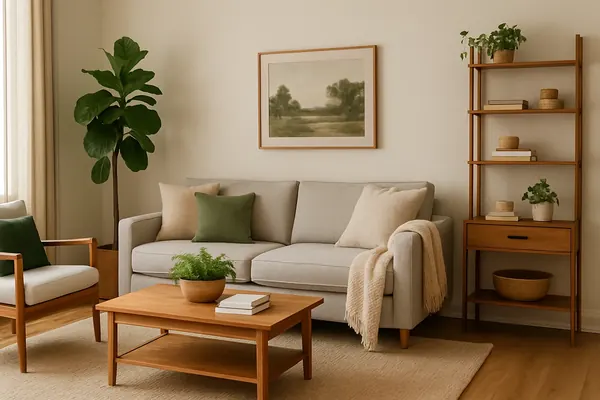
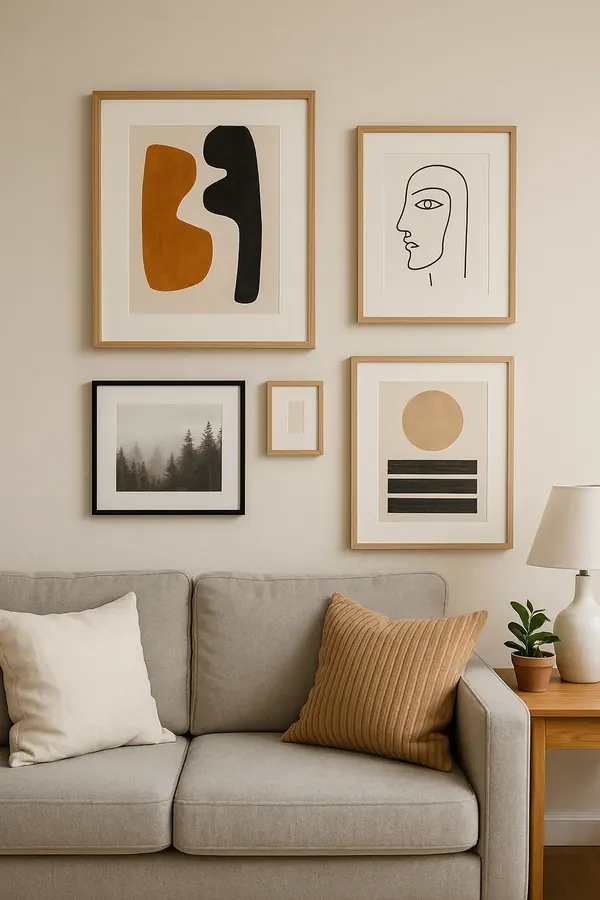
Decor & Styling
How to Hang Wall Art: Heights, Spacing & Layouts
The 57-inch rule, a simple nail height formula, sofa and bed spacing, gallery wall layouts and the right hardware for heavy art, all in one guide.
Free design tool
Enter your art size, hanger drop, and ceiling or furniture height, and this art hanging calculator tells you exactly where to put the nail. It uses the gallery-standard 57-inch center line and adjusts for art above sofas, beds, and gallery walls.
Results are planning guidelines based on standard interior design rules of thumb. Always measure twice and check product dimensions before you buy.
The calculator centers art at 57 inches (145 cm) above the floor by default, the eye-level standard used by many galleries and museums. You can switch to 60 inches (152 cm) if you prefer a slightly higher line, which suits taller households and rooms where people mostly stand. Hanging every piece on the same center line gives your apartment a consistent visual horizon, one of the quiet details that makes a home look professionally styled.
Most people hang art too high, often near the ceiling. That disconnects the art from the furniture and the people in the room. Bringing it down to eye level instantly makes a space feel more intentional.
Knowing the center height is only half the job, because the nail does not go at the center. The calculator uses this formula:
Nail height = center height + (art height / 2) − hanger drop
The hanger drop is the distance from the top of the frame down to the hanging point: pull the wire taut toward the top of the frame and measure, or measure down to the D-ring or sawtooth hook. Here are a few worked examples at a 57-inch center:
| Art height | Hanger drop | Calculation | Nail height |
|---|---|---|---|
| 16 in. | 2 in. | 57 + 8 − 2 | 63 in. |
| 24 in. | 3 in. | 57 + 12 − 3 | 66 in. |
| 30 in. | 4 in. | 57 + 15 − 4 | 68 in. |
| 36 in. | 5 in. | 57 + 18 − 5 | 70 in. |
| 48 in. | 6 in. | 57 + 24 − 6 | 75 in. |
For pieces with two D-rings, use the same formula for the height, then space two nails to match the distance between the rings, centered on the wall or furniture.
When art hangs above furniture, the furniture sets the height instead of the 57-inch rule. Leave 8 to 10 inches (20 to 25 cm) between the top of the sofa back, headboard, or console and the bottom of the frame. Any higher and the art floats away; any lower and heads will bump it.
Width matters as much as height. Aim for art, or a grouping, that spans about two-thirds of the furniture width, anywhere from 60 to 75 percent.
| Furniture | Typical width | Ideal art width (60–75%) |
|---|---|---|
| Loveseat | 60 in. | 36–45 in. |
| Standard sofa | 84 in. | 50–63 in. |
| Queen headboard | 62 in. | 37–47 in. |
| King headboard | 78 in. | 47–59 in. |
| Console or dresser | 48 in. | 29–36 in. |
If a single piece in that width is out of budget, hang two matching prints side by side or build a small grid. Our apartment living room ideas show how art and seating work together.
For gallery walls, keep 2 to 3 inches (5 to 8 cm) between frames and hold that spacing consistent across the whole arrangement. Then treat the group as one piece: find the outer edges of the entire arrangement, and center that shape at 57 to 60 inches, or start it 8 to 10 inches above the furniture below. Lay frames out on the floor first, or trace each frame onto kraft paper, tape the templates to the wall, and mark nail positions directly on the paper.
Anchor a mixed gallery wall with one larger piece slightly off center and build outward, aligning either a strong horizontal line through the middle or matching outer edges. Our full guide to how to hang wall art covers grid, salon, and ledge layouts in detail.
With ceilings above 9 feet, a 57-inch center can leave a lot of empty wall overhead. The calculator lets you shift the center slightly higher, a few inches at most, so the art relates to the volume of the room without losing its connection to eye level. A better fix is often to go bigger: oversized art or a taller gallery arrangement fills the wall while the center stays near eye level.
Designer tip: In a rental, mark your nail height with a small piece of painter's tape before you drill, and check it from across the room. For lightweight frames, adhesive strips rated for the weight avoid holes entirely; for heavier pieces, a single small nail hole is usually easy to patch at move-out.
Renters have more hanging options than they think. See our renter friendly upgrades for hole-free ideas, and our guide on how to make your apartment look expensive for why well-hung art matters so much.
Hang art so its center sits 57 to 60 inches above the floor, roughly average eye level. Museums and galleries use 57 inches as a standard. On a wall with no furniture, this rule works for almost any size piece. If your ceilings are higher than 9 feet, you can nudge the center a little higher so the art relates to the taller wall.
Leave 8 to 10 inches between the top of the sofa back and the bottom of the frame. That gap keeps the art visually connected to the sofa so they read as one composition. Aim for art that spans about two-thirds of the sofa width, between 60 and 75 percent. A single small piece above a long sofa will look lost.
Add half the art's height to your center height, then subtract the hanger drop, which is the distance from the top of the frame to the taut wire or hook. For a 24 inch tall frame with a 3 inch drop centered at 57 inches, the nail goes at 57 plus 12 minus 3, or 66 inches from the floor.
Space frames 2 to 3 inches apart on a gallery wall, keeping the gaps consistent throughout. Tighter spacing makes the arrangement read as one large piece, which is the goal. Treat the whole group as a single artwork, center it at 57 to 60 inches, or 8 to 10 inches above furniture, and lay it out on the floor or with paper templates first.
The 57 inch rule says the center of a piece of art should sit 57 inches above the floor, the average human eye level and a standard used by many galleries. Hanging every piece in your home on the same center line also creates a consistent horizon from room to room, which makes the whole apartment feel more considered.
The 57-inch rule, a simple nail height formula, sofa and bed spacing, gallery wall layouts and the right hardware for heavy art, all in one guide.
Layouts, clearances, rug sizes, lighting and renter-friendly decor to make an apartment living room of any size feel calm, finished and high-end.
Lighting, hardware, removable wallpaper and smarter ways to hang art: renter friendly upgrades rated by cost, difficulty and how easily you can undo them.