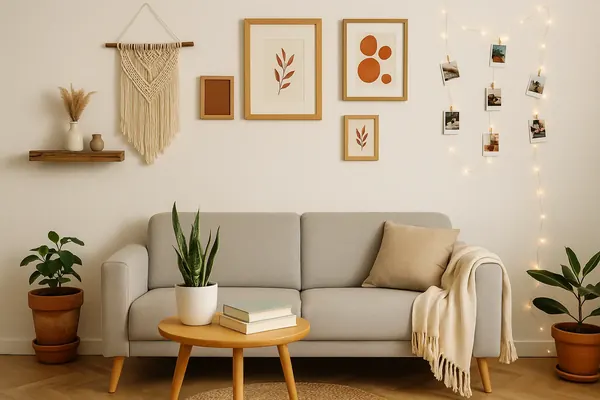
Apartment Living Room Ideas: Layouts, Furniture Sizing and Decor That Looks High-End
Layouts, clearances, rug sizes, lighting and renter-friendly decor to make an apartment living room of any size feel calm, finished and high-end.
Key takeaways
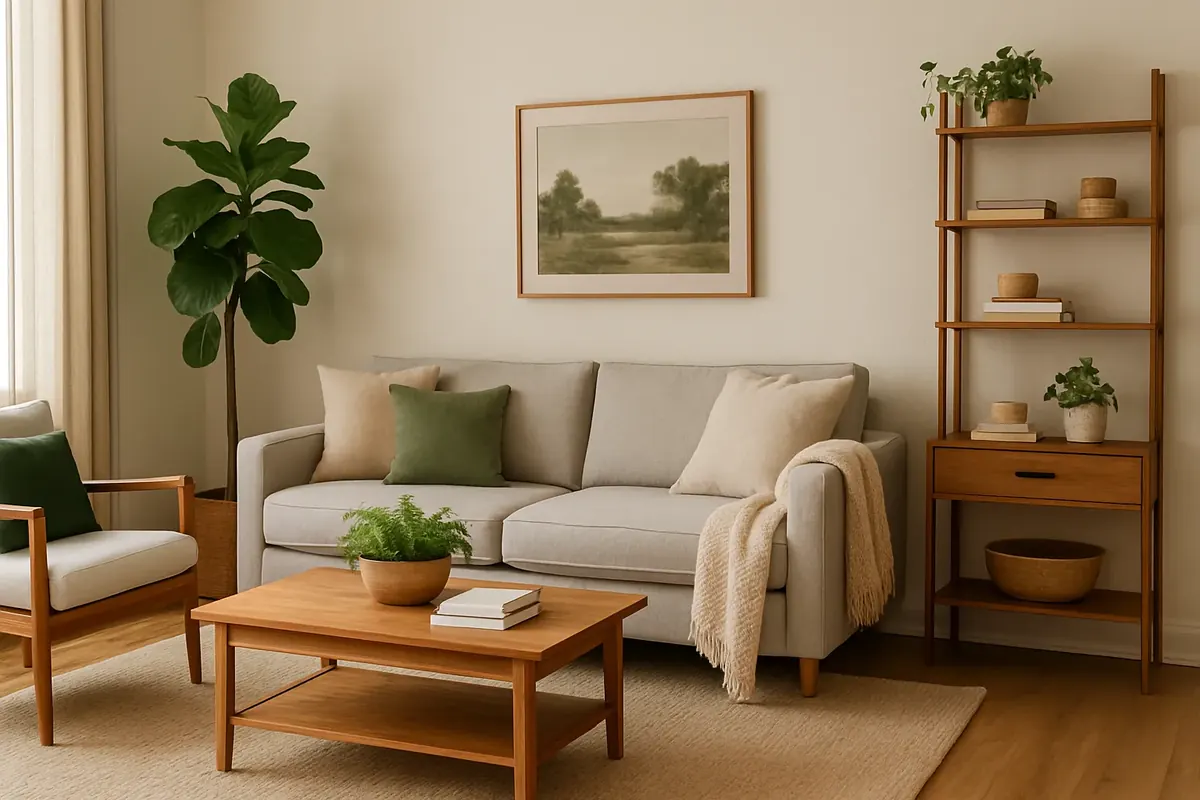
- Plan the layout first: keep 36 in. walkways and 16 to 18 in. between the sofa and coffee table.
- Choose an apartment-size sofa (72 to 84 in.) on visible legs to keep a small room feeling open.
- Size the rug so at least the front legs of every seat sit on it; 8 x 10 ft suits most 12 x 14 ft rooms.
- Layer ambient, task and accent lighting in warm 2700K bulbs on dimmers.
- Hang curtains high and wide and choose one large piece of art over several small ones.
The best apartment living room ideas don't depend on square footage. They come down to three decisions: a layout that lets people move, furniture sized for the room you actually have, and a small number of good materials repeated with intent. When you get those right, a 12 x 14 ft rental living room can feel as calm and finished as a much larger room in a design magazine.
This guide covers all three. You'll get furniture clearances in inches, layouts for the most common apartment floor plans, a rug sizing table, and lighting and decor ideas that work without drilling into every wall. The ideas are written for renters and for anyone working with builder-grade finishes, a TV wall you didn't choose, and one window you're trying not to block.
Start with layout, because no amount of styling fixes a room you can't walk through. Then work outward to rugs, lighting, textiles and art.
Start With the Layout: How to Arrange Furniture in an Apartment Living Room
Before you buy anything, measure the room and mark every door swing, radiator, vent, outlet and window. Draw it on graph paper at 1/4 in. = 1 ft, or use the room layout planner to drag scaled furniture around before you commit. Apartment living rooms usually have at least one fixed constraint, such as a wall of windows, a pass-through to the kitchen or an entry door that opens straight into the room. Your layout has to work around it.
Pick one focal point
Decide what the seating should face: a window with a view, a TV, a fireplace or a large piece of art. In many apartments the TV wall and the window wall are different, which pulls the room two ways. If you can, put the TV on the wall next to the window rather than opposite it, which cuts glare, and angle the sofa so both are in view.
Keep the clearances that make a room feel expensive
Cramped rooms rarely look high-end. These are the standard spacing guidelines designers use, and they're the numbers worth protecting even in a small room.
| Clearance | Recommended distance | Minimum in a tight room |
|---|---|---|
| Main walkway through the room | 36 in. (91 cm) | 30 in. (76 cm) |
| Sofa edge to coffee table | 16–18 in. (41–46 cm) | 14 in. (36 cm) |
| Between facing sofas or chairs | 7–9 ft for conversation | 6 ft |
| Seating to TV (1080p/4K, 55 in. screen) | about 7–8 ft | about 5.5 ft (4K) |
| Side table height vs. sofa arm | within 2 in. of arm height | no taller than 4 in. above |
| Coffee table length vs. sofa | about 2/3 of sofa length | half of sofa length |
Float the sofa if you can
Pushing every piece against the walls is the most common apartment living room mistake. Pulling the sofa even 6–12 in. off the wall gives the room breathing space and makes it look intentional. If the living room opens onto a dining area or entry, floating the sofa with its back to that space creates a clear "room within a room." Put a slim console table (10–14 in. deep) behind it for a lamp and a few objects so the back of the sofa looks finished.
Designer tip: Tape the outline of your sofa, coffee table and rug on the floor with painter's tape and live with it for a day. If you trip over a corner or squeeze past the coffee table, the piece is too big or in the wrong place.
Apartment Living Room Layouts That Work
Most apartment living rooms fall into one of a few shapes. Here's how to approach each.
The long, narrow living room
Divide the length into two zones instead of lining everything along one wall. Put the main seating group (sofa, two chairs or a sofa and a chair, coffee table) at one end on a rug, and use the other end for a reading chair, a small desk or a round dining table. A rug under each zone tells the eye where one area ends and the next begins. Avoid placing the sofa on the long wall facing a TV only 6 ft away. Turning the sofa to face the short wall often gives better viewing distance and walking room.
The square living room
Square rooms suit symmetry. Center the sofa on the focal wall, place two chairs opposite or at the ends, and anchor the group with a square or round coffee table. An L-shaped sectional also works well in a square room when it sits in one corner and leaves the opposite corner open for a plant, floor lamp or bar cart.
The open-plan living room
When the living room shares space with the kitchen or dining area, furniture does the job walls would normally do. Use the back of the sofa to define the edge of the living zone, keep a 36 in. path behind it, and choose a rug that sits entirely inside the seating area rather than running into the dining zone. Repeat one or two colors or materials across all zones, such as the wood tone of the dining table echoed in a side table, so the whole space reads as one apartment instead of three rooms competing.
The studio or living-bedroom combo
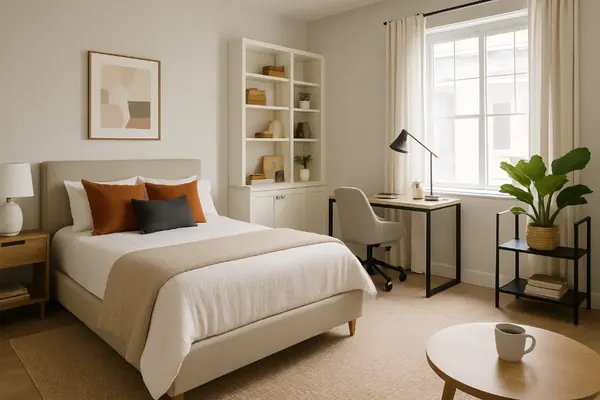
If your living room is also your bedroom, the layout rules change. A bookcase, a curtain on a ceiling track or a sofa with its back to the bed can separate sleeping from lounging. Keep the bed visually quiet with bedding in the same palette as the sofa so the room reads as one calm space.
Small Apartment Living Room Ideas: Furniture That Fits
In a small apartment living room, scale matters more than style. Oversized furniture crowds a room, but furniture that's too small makes it look temporary, like a dorm. The aim is fewer, better-proportioned pieces.
- Choose an apartment-size sofa. Look for 72–84 in. long with a seat depth of 21–23 in. Track arms or slim arms (under 6 in. each) give you more seat width in the same footprint than rolled arms.
- Raise furniture on legs. Sofas, chairs and media consoles on visible 4–6 in. legs show more floor, which makes the room feel larger.
- Swap a coffee table for nesting or round tables. A 30–36 in. round coffee table is easier to walk around than a rectangle, and nesting tables pull apart when guests arrive.
- Use armless chairs or slipper chairs. They seat a person in about 24 in. of width, compared with 30–36 in. for a typical armchair.
- Go vertical with storage. A tall, shallow bookcase (10–12 in. deep) holds more than a low credenza and draws the eye upward.
- Pick a wall-mounted or slim media console. A 12–16 in. deep console frees up floor space, and many renters can use a TV stand with a mount pole instead of drilling.
For more space-saving strategies across the whole apartment, see our guide to small apartment ideas.
A small living room with five well-chosen pieces will always look more expensive than a large one with fifteen.
What Size Rug Should You Use in an Apartment Living Room?
An undersized rug is the fastest way to make a living room look unfinished. The rug should connect the seating pieces, not float in the middle of them. The standard guideline is that at least the front legs of the sofa and chairs sit on the rug, and the rug leaves about 12–18 in. of bare floor around the room's edges (8–12 in. is fine in a very small room).
| Room size | Typical rug size | Layout it suits |
|---|---|---|
| Under 10 x 12 ft | 5 x 8 ft | Loveseat or small sofa plus one chair, front legs on |
| 10 x 12 ft to 12 x 14 ft | 6 x 9 ft or 8 x 10 ft | Sofa and two chairs, front legs on |
| 12 x 15 ft to 14 x 18 ft | 8 x 10 ft or 9 x 12 ft | Sofa, chairs and side tables, all legs on or front legs on |
| Open-plan living zone | Sized to the seating group plus 6–12 in. | Defines the living area only |
Not sure which size fits your room? Enter your dimensions in the rug size calculator to get a recommended size and placement. When the right size is out of budget, buy a large, inexpensive jute or sisal rug as a base and layer a smaller patterned or vintage-style rug on top. The layered look reads as deliberate, and it costs far less than one big wool rug.
Renter note: A rug pad isn't optional on rental hardwood or laminate. A felt-and-rubber pad keeps the rug from sliding, protects the floor finish and helps with noise for your downstairs neighbors. Avoid pure PVC pads, which can discolor some floor finishes.
Lighting Ideas for an Apartment Living Room
Most apartments come with one overhead fixture, or none at all, plus a switched outlet. That's why so many rental living rooms feel flat at night. Good lighting comes in three layers, and you can add all of them without an electrician.
- Ambient light: General illumination. If you have a ceiling fixture, swap the builder-grade shade for a linen drum or paper lantern (keep the original to reinstall when you move out). If you don't, use two or three floor lamps spread around the room.
- Task light: A swing-arm or adjustable floor lamp beside your reading spot, and a table lamp on the console or side table. Lampshade bottoms should sit around eye level when you're seated, roughly 38–42 in. from the floor.
- Accent light: Picture lights (battery or plug-in), LED strips under shelves, or a small uplight behind a plant. This is the layer that makes a room feel designed.
Use warm bulbs of 2700K throughout, and put lamps on plug-in dimmers or smart plugs so you can lower the light in the evening. A rough target for a living room is 10–20 lumens per square foot across all sources. A 150 sq ft room needs about 1,500–3,000 lumens in total. If you want soft, decorative glow on top of that, our guide to fairy lights in the living room shows how to use string lights in a grown-up way.
Living Room Decor Ideas for Apartments That Look High-End
Commit to a tight color palette
Choose one dominant neutral (walls, sofa, rug), one secondary color (chairs, curtains, a large piece of art) and one accent (pillows, a vase, a book stack). This 60-30-10 split keeps a room calm. Warm whites, greige, mushroom, camel and deep olive photograph well and hide the wear of daily life better than stark white or gray.
Hang curtains high and wide
Mount the curtain rod 4–6 in. below the ceiling (or halfway between the window frame and the ceiling) and extend it 8–12 in. past each side of the frame. Panels should just kiss the floor. This one change makes ceilings look taller and windows look bigger. Most renters can use tension rods or install a rod with small screws and patch the holes when they move out.
Layer texture over pattern
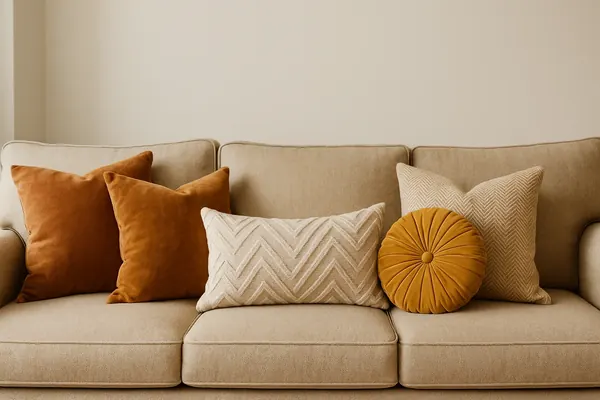
Expensive-looking rooms usually rely on texture rather than loud pattern: bouclé, linen, wool, leather, travertine, rattan, matte ceramic and aged brass. Aim for at least four different textures in the seating area. Throw pillows are the easiest place to start, and our guide on how to style pillows on a couch covers sizes and arrangements.
Scale art up
One large piece of art over the sofa, about two-thirds of the sofa's width, almost always looks better than several small frames. Hang it 8–10 in. above the sofa back with its center around 57–60 in. from the floor when it hangs on an empty wall. For renter-friendly hanging methods, see how to hang wall art.
Edit your surfaces
Group objects in odd numbers and vary their heights: a stack of two or three hardcover books, a small bowl and one taller item like a vase with branches. Leave at least a third of every surface empty. Clutter is the main thing that makes a rental look cheap.
Renter-Friendly Upgrades for a Living Room
You can change a lot in a rental living room without risking your deposit. These are the upgrades with the biggest visual return.
- Replace the ceiling fixture shade or the whole fixture (store the original and reinstall it before you move out).
- Add plug-in wall sconces with cord covers painted the wall color.
- Use removable peel-and-stick wallpaper on one wall or inside bookshelves (test a small patch first).
- Swap mini blinds for linen curtains or a tension-mounted Roman shade.
- Lean a large floor mirror opposite the window to bounce daylight.
- Cover dated radiators or baseboard heaters with a freestanding cover (keep the clearance the manufacturer specifies).
- Bring in two or three large plants, such as an olive tree, fiddle-leaf fig or snake plant, in heavy ceramic pots.
For a longer list, including kitchen and bathroom swaps, read our guide to renter friendly upgrades.
Apartment Living Room Ideas by Budget
These are typical price ranges for a small to medium apartment living room. Actual costs vary by city, retailer and how much you already own.
| Budget (typical range) | Where to spend | Where to save |
|---|---|---|
| Under $500 | Rug in the right size, curtains hung high, two warm-white lamps | Thrifted side tables, existing sofa with new pillow covers |
| $500–$2,000 | Add one statement piece: a large artwork, a good accent chair or a quality rug | Flat-pack shelving, secondhand coffee table |
| $2,000–$5,000 | A well-built, apartment-size sofa you'll keep for years | Decor accessories, which are easy to upgrade later |
| $5,000+ | Sofa, rug and lighting as long-term investments | Trend pieces and seasonal textiles |
If you're working from a fixed number, decide what share goes to the sofa before you shop, often a third to half of the total, so it doesn't swallow everything.
Putting It All Together: A Step-by-Step Plan
If you're starting from scratch, or starting over, work in this order. Each step builds on the one before it, so you won't buy a rug that doesn't fit or art that fights your palette.
- Measure and plan. Draw the room, mark constraints and choose your focal point.
- Place the sofa. Size it to the room and decide whether it floats or sits against a wall.
- Size the rug. Choose a rug that holds at least the front legs of every seat.
- Add secondary seating and tables. Keep 36 in. walkways and 16–18 in. to the coffee table.
- Layer the lighting. Add ambient, task and accent light in 2700K on dimmers.
- Hang curtains and art. Go high and wide with curtains, and choose large-scale art.
- Style last. Add pillows, throws, plants and objects, then edit by removing one thing from each surface.
A great apartment living room comes together in layers over time. Get the bones right first, which means layout, scale and light, and every pillow, print and plant you add afterward will look intentional. For whole-apartment ideas that carry this approach into other rooms, explore our guide to making your apartment look expensive.
Free interactive tool
Rug Size Calculator: the right rug size for any room
Frequently Asked Questions
How do I arrange furniture in a small apartment living room?
Choose one focal point, place the sofa facing it, then add one or two chairs to form a conversation group. Keep a 30 to 36 inch walkway, leave 16 to 18 inches between the sofa and coffee table, and float the sofa a few inches off the wall if space allows. Anchor the group with a rug that holds the front legs of every seat.
What size sofa is best for an apartment living room?
Most apartment living rooms suit a sofa 72 to 84 inches long with a seat depth of 21 to 23 inches. Slim or track arms give more seating width in the same footprint, and raised legs make the room feel larger. In rooms under 10 by 12 feet, a loveseat around 60 to 70 inches plus an armless chair often works better.
Should a couch be against the wall in an apartment?
Not necessarily. Pulling the sofa even 6 to 12 inches off the wall makes a room look more intentional, and floating it in an open-plan apartment defines the living zone. In very narrow rooms where you need every inch of walkway, placing it against the wall is fine. Add a slim console behind a floating sofa so the back looks finished.
What size rug do I need for an apartment living room?
For a typical 10 by 12 to 12 by 14 foot apartment living room, a 6 by 9 or 8 by 10 foot rug works best. The front legs of the sofa and chairs should rest on the rug, with roughly 12 to 18 inches of bare floor around the room's edges. Smaller rooms under 10 by 12 feet usually suit a 5 by 8 foot rug.
How can I make my apartment living room look expensive on a budget?
Focus on a correctly sized rug, curtains hung high and wide, warm 2700K lamps on dimmers, and one large piece of art. Stick to a tight color palette, mix textures like linen, wool and wood, and clear at least a third of every surface. These changes typically cost a few hundred dollars and make the biggest visual difference.

We research designer standards, measure real rooms and test every recommendation against apartment realities: tight footprints, lease rules and budgets. How we write our guides.