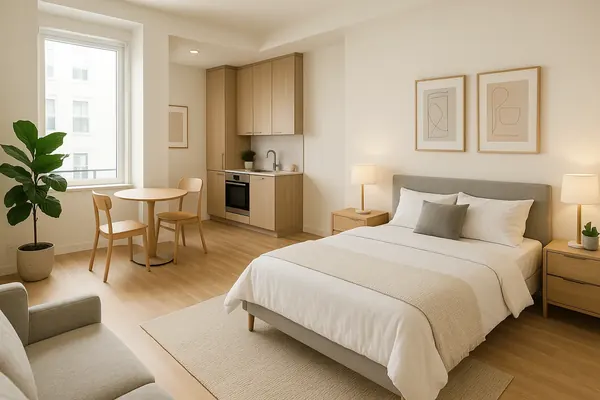
Small Apartment Ideas: How to Plan, Store and Decorate a Small Space That Feels Bigger
Layout clearances, vertical storage, and designer tricks that make a small apartment feel bigger, calmer, and more expensive.
Key takeaways
- Plan the layout first: keep main walkways 30 to 36 inches wide and measure before you buy.
- Choose fewer, properly scaled pieces instead of many small ones.
- Use vertical and multi-use storage, such as tall bookcases, storage beds, and ottomans.
- Hang curtains high and wide, add a large mirror near a window, and light every room from at least three sources.
- Keep a tight two- or three-color palette and add richness through texture.
The best small apartment ideas do three things at once: they free up floor space, they give every object a home, and they trick the eye into reading the room as larger than it is. You do not need a renovation budget to get there. A smarter layout, furniture with visible legs, storage that climbs the walls, and a tight color palette will change how a 450 or 650 square foot apartment feels more than any single purchase.
This guide walks through the decisions in the order that matters. First comes layout, because no amount of decorating fixes a sofa blocking the only walkway. Then storage, then the visual tricks that make a small apartment look bigger, and finally the decorating details that make it feel finished and expensive rather than merely tidy. Measurements, clearances, and typical budget ranges are included so you can plan before you buy.
Everything here is renter-friendly unless noted. Where an idea needs drilling or a landlord's permission, you will see a renter note.
Start With a Small Apartment Layout That Actually Flows
Layout is the foundation of every small apartment idea that works. Before you move a single piece of furniture, measure each room wall to wall, mark windows, radiators, outlets, and door swings, and sketch it on graph paper or in the room layout planner. Seeing the plan to scale stops you from buying an 88-inch sofa for a wall that only gives you 80 usable inches.
Protect your walkways first
Circulation paths are what make a room feel spacious or cramped. Plan these minimum clearances before you place anything else:
| Clearance | Minimum | Comfortable |
|---|---|---|
| Main walkway through a room | 30 in. (76 cm) | 36 in. (91 cm) |
| Sofa to coffee table | 14 in. (36 cm) | 16–18 in. (41–46 cm) |
| Behind a dining chair (to pull out and sit) | 32 in. (81 cm) | 36 in. (91 cm) |
| Beside a bed (to get in and make it) | 24 in. (61 cm) | 30 in. (76 cm) |
| In front of a dresser or closet | 30 in. (76 cm) | 36 in. (91 cm) |
| Galley kitchen aisle | 36 in. (91 cm) | 42 in. (107 cm) |
Float one piece, anchor the rest
Pushing every piece against the walls feels like it saves space, but it often creates an empty, awkward middle and a room that looks like a waiting area. In a living area at least 11 feet wide, try pulling the sofa 6 to 12 inches off the wall, or float it to create a hallway behind it that leads to the bedroom or kitchen. Keep tall, heavy pieces like bookcases and wardrobes on the walls, and let lower pieces sit closer to the center.
Choose the right scale, not the smallest size
Doll-sized furniture makes a room look busier, because you end up with more pieces. Aim for fewer, properly scaled items: a 72- to 80-inch apartment sofa instead of a loveseat plus two chairs, a 36-inch round dining table instead of a rectangle with corners that block paths, and one large rug instead of several small ones. Use the rug size calculator so the front legs of your seating sit on the rug; an undersized rug is one of the fastest ways to make a room feel smaller.
Designer tip: Tape the footprint of a new piece on the floor with painter's tape and live with it for two days before you buy. If you keep stepping around the tape, the piece is too big.
Small Apartment Storage Ideas That Do Not Look Like Storage
Most small apartments lack closets, not square footage. The goal is to add storage that reads as furniture or architecture, so the room looks calm instead of crammed with bins.
Go vertical, all the way up
The space between 72 inches and the ceiling is the most underused real estate in a small apartment. Floor-to-ceiling bookcases, tall wardrobes, and shelves that run above door frames give you storage without using more floor. A tall, narrow piece also draws the eye upward, which makes ceilings feel higher. Keep the top shelves for things you use a few times a year, and put matching lidded boxes there so the top of the wall looks orderly.
Pick furniture that does two jobs
- Storage bed: a platform bed with drawers or a hydraulic lift-up base can hold the contents of a small dresser. Lift-up bases hold more; drawers are easier for daily items but need about 24 inches of clearance to open.
- Ottoman or trunk as coffee table: holds throws, games, and chargers, and doubles as extra seating.
- Drop-leaf or extendable table: seats two at 30 inches wide and four or six when opened for guests.
- Console behind the sofa: a 10- to 14-inch-deep console works as a desk, a bar, or a landing spot for keys and mail.
- Bench with cubbies by the door: creates an entry zone for shoes and bags even when there is no foyer.
Use the hidden zones
Look at the back of every door, the space under the sink, the top of the refrigerator, and the gap beside the washer. Over-the-door organizers, stackable under-sink drawers, and slim rolling carts (5 to 7 inches wide) turn dead space into pantry and cleaning storage. Inside closets, double hanging rods instantly double the capacity for shirts and folded trousers.
Renter note: Tall bookcases and wardrobes should be anchored to the wall to prevent tipping, which means small screw holes. Most landlords accept anti-tip anchors because they are a safety measure, but ask first and fill the holes with spackle when you move out.
Edit before you organize
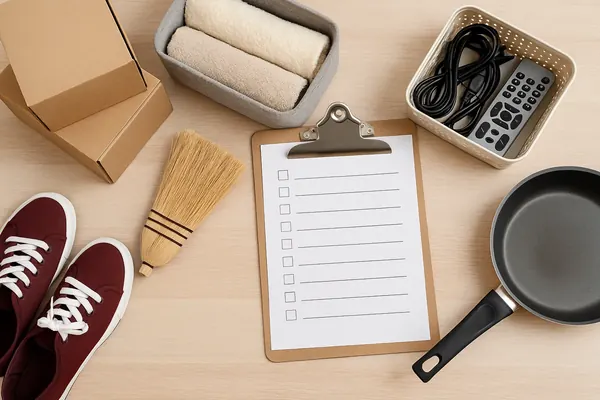
No storage system can hold more than the space allows. Before you buy bins or baskets, work through a room-by-room purge with our declutter checklist. Most people find they can free a full shelf per room just by removing duplicates, expired items, and things they are keeping out of guilt.
How to Make a Small Apartment Look Bigger
Once the layout and storage are under control, you can use proportion, light, and color to make a small apartment look bigger. These are the techniques interior designers lean on most.
Choose leggy furniture
When you can see the floor continue under a sofa, chair, or console, your brain reads the room as more open. Look for pieces raised 6 to 8 inches on slim legs. Glass, acrylic, and open-frame metal tables take this further because they almost disappear visually.
Hang curtains high and wide
Mount the curtain rod 4 to 6 inches below the ceiling (or halfway between the window frame and the ceiling) and extend it 8 to 12 inches past each side of the frame. Panels should just kiss the floor. The window looks taller and wider, and more daylight reaches the room when the curtains are open. The curtain size calculator gives you rod length and panel widths.
Use mirrors where they reflect light
A large mirror placed opposite or beside a window bounces daylight deeper into the room. A floor mirror at least 65 inches tall, leaned against a wall, adds depth in a living room or bedroom. Avoid placing a mirror where it reflects clutter, a blank wall, or the kitchen sink.
Keep the palette tight
A limited palette of two or three colors with variations in tone creates continuity, and continuity reads as space. Light, warm neutrals such as soft white, greige, and oatmeal reflect the most light, but a deep color painted on every wall and the ceiling can also blur corners in a small bedroom. What hurts small spaces is contrast for its own sake: many unrelated colors, patterns, and finishes competing for attention.
Layer the lighting
One overhead fixture flattens a room and makes corners disappear into shadow. Use at least three sources per room: ambient (a ceiling fixture or plug-in pendant), task (a reading lamp or under-cabinet strip), and accent (a picture light or a small lamp on a shelf). Light in the corners pushes the walls out visually. Warm bulbs around 2700K feel the most residential and flattering.
| Trick | Why it works | Typical cost |
|---|---|---|
| Curtains mounted high and wide | Makes windows and ceilings read taller | $60–$250 for rod and panels |
| Large leaning mirror | Reflects light and doubles visual depth | $100–$400 |
| Leggy sofa and chairs | Shows more floor, lightens visual weight | Varies; choose at replacement time |
| Three-point lighting | Removes dark corners, adds depth | $80–$300 for two to three lamps |
| One large rug instead of several small | Unifies the zone and widens the floor | $150–$600 for an 8 x 10 ft |
| Same color on walls and trim | Removes visual breaks, blurs edges | $60–$150 in paint, if allowed |
Space is mostly a feeling. Light, sightlines, and a clear floor create it faster than square footage ever will.
Small Apartment Decorating Ideas With a High-End Look
Small apartment decorating ideas often stop at "keep it minimal," which can leave a room feeling sterile. A small space can absolutely hold warmth, art, and personality; it just needs fewer, better choices.
Go bigger with fewer accessories
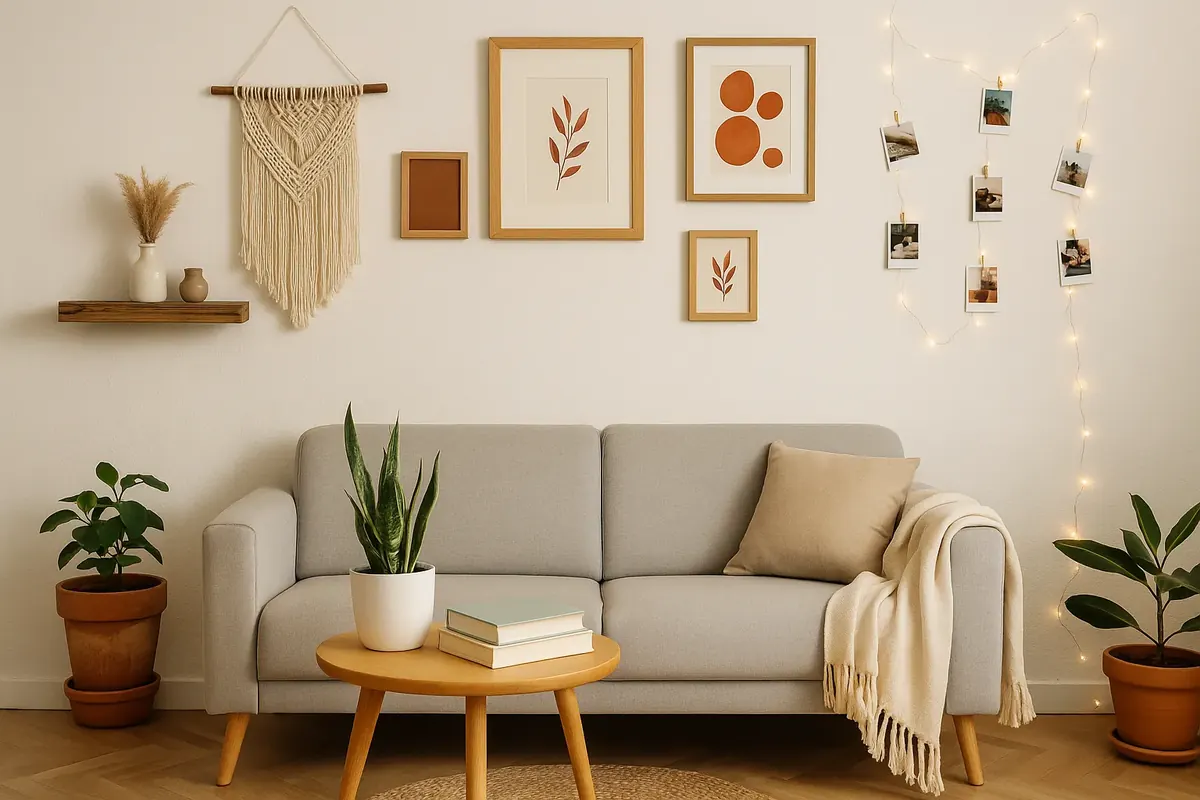
One 30 x 40 inch piece of art reads as intentional; eight small frames can look like clutter in a tight room. The same goes for decor objects: a large vase with branches says more than five small trinkets. If you love a gallery wall, keep the frames consistent in color and the spacing tight (2 to 3 inches), and follow the height rules in our guide on how to hang wall art.
Mix in texture instead of color
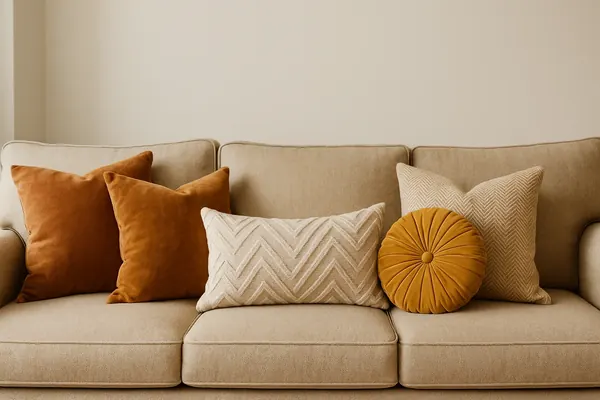
Texture adds richness without adding visual noise. Pair a boucle or linen sofa with a wool rug, a ribbed ceramic lamp, a walnut side table, and a brushed brass accent. Several textures in the same color family look layered and expensive, which is the backbone of how to make your apartment look expensive on a budget.
Upgrade the touchpoints
Hardware, switch plates, and light fixtures are small, but your hand and eye meet them constantly. Swapping builder-grade cabinet knobs for solid brass or matte black pulls, or replacing a basic ceiling dome with a plug-in pendant, changes how the whole apartment reads. Our guide to renter friendly upgrades covers dozens of reversible swaps like these.
Bring in plants, but edit them
One large floor plant (a fiddle-leaf fig, olive tree, or bird of paradise) in a corner adds height and life. Several tiny plants scattered across every surface just create more things to dust. Group small plants together on one tray or a single shelf.
How to Divide a Small Apartment Into Zones
When one room has to be living room, office, dining room, and sometimes bedroom, zoning is what keeps it from feeling like a jumble. Each zone should have its own anchor, its own light source, and a clear edge.
- Rugs: the simplest zone marker. A rug under the seating area and another under a dining table instantly separate the two functions.
- Open shelving: a back-to-back or open-backed bookcase divides space while letting light through. Keep it no deeper than 12 to 15 inches.
- Curtains on a ceiling track: a floor-to-ceiling curtain hides a bed or desk at night and opens fully during the day.
- Folding screens: movable, cheap, and good for hiding a workspace after hours.
- Lighting: a pendant over the dining table and a floor lamp beside the sofa tell your brain these are two different places.
If you live in one open room, our deeper guide to studio apartment ideas includes layouts for 400, 500, and 600 square foot studios.
Room-by-Room Small Apartment Ideas
Living room
Choose a sofa no deeper than 36 inches and one accent chair rather than two. Use a round or oval coffee table, which keeps paths open and is kinder to shins. A wall-mounted TV on a renter-friendly floor stand or a slim 12- to 16-inch-deep media console saves the space a bulky entertainment center would consume.
Bedroom
A full bed (54 x 75 inches) fits a 9 x 10 foot room with walkways on two sides; a queen (60 x 80 inches) generally wants at least 10 x 10 feet. Replace nightstands with wall-mounted shelves or narrow 12- to 15-inch tables, and swap bedside lamps for plug-in wall sconces to clear the surfaces. Use the under-bed zone for out-of-season clothing in fabric bins.
Kitchen
Add a rolling cart or a small butcher-block island if you have the 36-inch clearance around it. Use magnetic knife strips, rail systems with S-hooks, and shelf risers inside cabinets to double usable space. Open shelves above the counter should hold only the dishes you use daily, stacked neatly.
Bathroom
Over-the-toilet shelving, a recessed or surface-mounted medicine cabinet with a mirrored face, and hooks instead of towel bars all buy space. A clear glass shower panel or a curtain hung close to the ceiling keeps the room from feeling chopped in half.
Entry
Even without a foyer, create a landing zone: a slim wall shelf or 10-inch console, a mirror above it, wall hooks at 60 to 66 inches, and a tray for keys. It stops the pile of shoes and bags from spreading into the living room.
Small Apartment Ideas on a Budget
You can transform a small apartment over a weekend or over a year. Here is how typical spend usually breaks down, from the highest-impact, lowest-cost moves to bigger investments.
| Budget tier | What to do | Typical range |
|---|---|---|
| Under $100 | Declutter, rearrange furniture, swap bulbs to warm 2700K, add hooks and over-door organizers | $0–$100 |
| $100–$500 | Curtains hung high, a large mirror, a rug that fits the zone, new cabinet hardware | $100–$500 |
| $500–$1,500 | Storage bed or tall wardrobe, plug-in sconces, a drop-leaf table, large-scale art | $500–$1,500 |
| $1,500 and up | A properly scaled sofa, custom closet system, built-in look with tall bookcases | $1,500–$5,000+ |
Spend first on the things you touch every day (your bed, your sofa, your lighting) and save on decor objects you can rotate later. Secondhand solid wood pieces are often better value and better built than new flat-pack furniture at the same price.
Common Small Apartment Mistakes to Avoid
- Buying furniture before measuring: include doorways, stair turns, and elevator depth, not just the room.
- Too many small pieces: five little tables and stools take up more visual space than one larger, well-chosen piece.
- A rug that floats in the middle: it makes the room look smaller. Size up.
- Curtains hung at the window frame: they make ceilings look lower.
- Relying on one overhead light: the room will feel flat and smaller after dark.
- Open shelving full of mismatched items: open storage needs editing; put the mess behind doors.
- Blocking the window: never put a tall piece in front of your main light source.
Putting It All Together: Your Small Apartment Plan
Work through these steps in order, and you will avoid the most expensive mistakes.
- Measure every room, doorway, and window, and draw a scaled floor plan.
- Declutter room by room before buying any storage.
- Map walkways at 30 to 36 inches and place the largest pieces first.
- Choose multi-use furniture: storage bed, ottoman, drop-leaf table.
- Add vertical storage that reaches toward the ceiling.
- Hang curtains high and wide, and add a large mirror near a window.
- Set a two- or three-color palette and layer texture within it.
- Give every room at least three light sources.
- Finish with fewer, larger pieces of art and one statement plant.
Small apartments reward intention. When every piece earns its place, the space feels calm, generous, and far more luxurious than its square footage suggests. Start with your floor plan and build from there.
Free interactive tool
Room Layout Planner: drag-and-drop furniture planner
Frequently Asked Questions
How can I make my small apartment look bigger?
Show more floor with leggy furniture, hang curtains 4 to 6 inches below the ceiling and extend the rod past the window, place a large mirror where it reflects daylight, and keep a tight color palette. Add lamps in the corners so the room does not shrink after dark, and size your rug so the front legs of the seating sit on it.
How do I arrange furniture in a small apartment?
Measure the room and draw it to scale, then protect a 30 to 36 inch walkway before placing anything. Put the largest piece, usually the sofa or bed, on the longest uninterrupted wall, keep tall storage against walls, and use a rug to anchor the seating zone. Leave 14 to 18 inches between sofa and coffee table.
What is the best storage for a small apartment with no closets?
A tall wardrobe or armoire, a lift-up storage bed, and a freestanding clothing rail with a curtain in front cover most needs. Add over-the-door organizers, a bench with cubbies at the entry, and lidded boxes on top of tall furniture. Declutter first so you only buy the storage you actually need.
What colors make a small apartment look bigger?
Light, warm neutrals such as soft white, greige, and pale oatmeal reflect the most light and make walls recede. Painting walls and trim the same color removes visual breaks. A single deep color on every surface of a small bedroom can also blur the corners. Avoid many unrelated colors competing in one room.
How do you decorate a small apartment without it looking cluttered?
Use fewer, larger accessories, such as one big piece of art instead of many small frames. Layer texture within a limited palette, group small plants or objects on a single tray, and keep open shelves edited. Put everyday mess behind doors with closed storage so surfaces stay mostly clear.

We research designer standards, measure real rooms and test every recommendation against apartment realities: tight footprints, lease rules and budgets. How we write our guides.