Fairy Lights in the Bedroom: Placement Ideas and DIY Projects With Step-by-Step Instructions
Headboard, canopy, mirror and window ideas for bedroom fairy lights, plus five step-by-step DIY projects and renter-safe hanging tips.
Key takeaways
- Focus on one main feature: headboard, canopy, mirror or window.
- Keep lights behind or above the headboard so they glow without shining in your eyes.
- Use furniture like the headboard, bed frame and curtain rod to avoid wall damage.
- Simple DIY projects such as a headboard halo or lit branch corner take under an hour.
- Use LEDs only, keep plugs off bedding and put lights on a timer.
Fairy lights in a bedroom do something a ceiling light can't: they give you a low, warm glow to wind down by, right where you spend the last hour of the day. The best bedroom fairy light ideas focus on four places: the headboard wall, a canopy over the bed, a mirror and the window. Pair those with a simple DIY project or two and the result looks considered, not like a dorm.
This guide is all about the bedroom. You'll find placement ideas with measurements, five DIY projects with step-by-step instructions, how to hang fairy lights in a bedroom without damaging walls, and the safety rules that matter when lights sit near bedding and curtains.
For the basics of choosing lights, start with warm white (2200–2700K), thin copper or brass wire and a steady, non-flashing mode. Our guide to fairy lights in the living room covers wire types, color temperature and dimmers in detail, so here we'll get straight to the bedroom.
Where to Put Fairy Lights in a Bedroom
Each placement creates a different effect. Choose one main feature, and at most one supporting spot, so the room stays calm.
| Placement | Effect | Typical string length | Difficulty |
|---|---|---|---|
| Behind a headboard | Soft halo, hidden source | 16–33 ft (5–10 m) | Easy |
| Draped above the bed | Focal wall, frames the bed | 20–33 ft (6–10 m) | Easy |
| Canopy over the bed | Enclosed, romantic | 33–66 ft (10–20 m) | Moderate |
| Around a mirror | Dressing-room glow, doubled light | 10–20 ft (3–6 m) | Easy |
| Window or curtain | Diffused wall of light | Curtain lights sized to window | Easy |
| Photo or memo display | Personal, functional | 10–16 ft (3–5 m) | Easy |
Designer tip: Keep fairy lights out of your direct line of sight when you're lying down. Lights behind or above the headboard glow without glaring; lights on the wall opposite the bed can feel like staring at a screen.
Fairy Lights Above the Bed: 4 Headboard Ideas
1. The hidden headboard halo
Fix a micro-wire string along the back edge of your headboard with adhesive cable clips, about 1 in. in from the edge and facing the wall. The light washes the wall behind the bed and outlines the headboard, and you never see a bulb. This works best with upholstered or wooden headboards that sit 2–4 in. off the wall.
2. Soft swags over the bed
Mark three or five evenly spaced points across the wall above the bed, roughly 12–18 in. above the headboard and extending 6–12 in. past each side of the bed. Hang the string in shallow loops between the points, with a drop of 4–8 in. per loop. Keep every loop the same depth; that's what makes it look deliberate.
3. Vertical drops as a "light headboard"
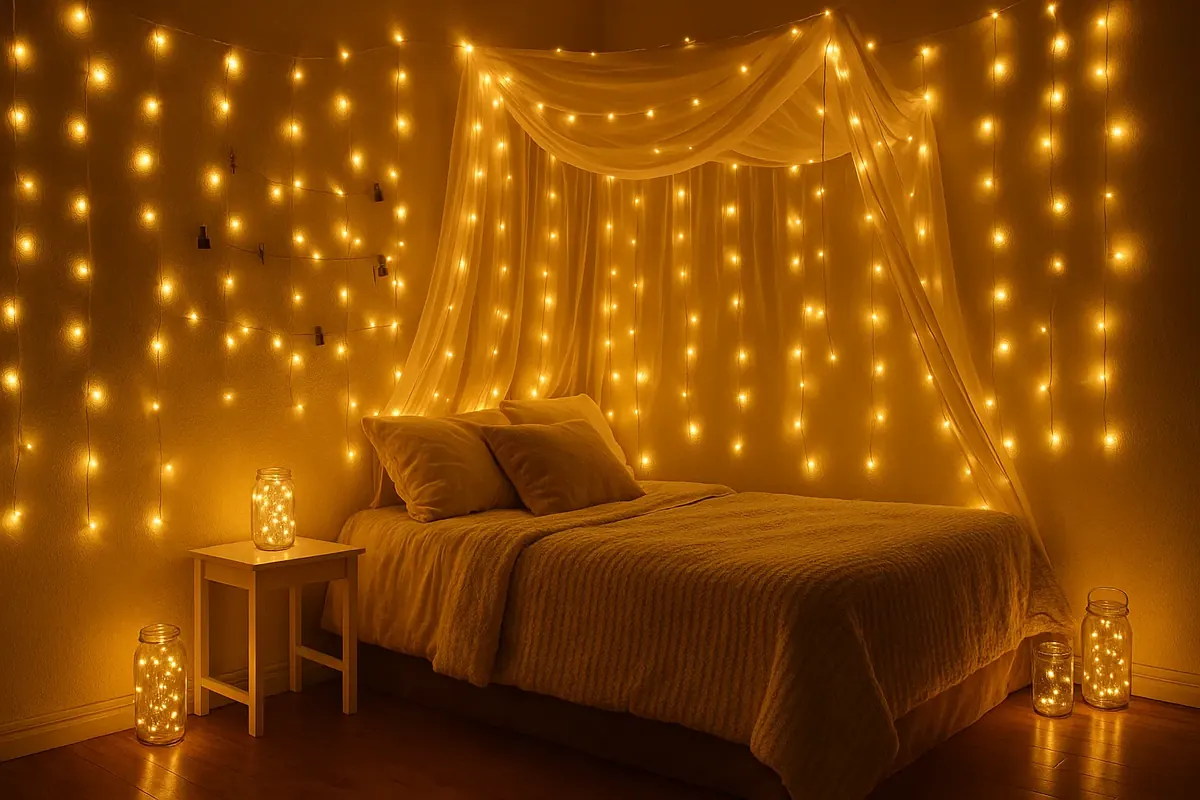
If you don't have a headboard, hang curtain lights or five to seven vertical strands from a slim rod or adhesive hooks mounted at the width of the bed. Let the strands stop at mattress height, so the light reads as a headboard shape. Hang a sheer panel in front for a softer, diffused version.
4. Lights through a headboard garland
Run a faux eucalyptus or olive garland along the top of the headboard or a picture ledge above it and weave a cluster string through it. Keep the greenery dense so the wire disappears.
Bedroom Canopy and Ceiling Ideas
A canopy is the most dramatic use of fairy lights in a bedroom, and it works especially well in rooms with plain, flat ceilings.
- Sheer canopy with lights behind: hang a ceiling-mounted canopy ring or a curtain track above the bed, drape sheer voile from it, and tuck lights inside the fabric so the whole canopy glows.
- Radiating ceiling lines: run four to six strands from a central point above the bed out to the corners of the bed area, like a tent. Keep the lines taut.
- Four-poster frame: wrap lights loosely around the top rails of a four-poster or canopy bed frame. This needs no wall or ceiling fixing, which makes it ideal for renters.
Renter note: Ceiling adhesives fail more often than wall adhesives, especially on textured "popcorn" ceilings. For canopies, use a four-poster frame, a freestanding canopy stand, or a single small ceiling hook (a tiny hole that's easy to fill), and check your lease before drilling.
Mirror and Window Fairy Light Ideas
Around a mirror
Frame a floor-length or dresser mirror with micro-wire lights tucked behind the edges so the glow spills outward. For a leaning mirror, wrap the string around the back of the frame and secure it with tape on the back. The reflection doubles the light and makes a small bedroom feel larger. Keep it subtle: this is ambient light, not a makeup light.
On a window
Hang curtain lights on a tension rod inside the window frame, behind sheer curtains. At night the sheers diffuse the light into an even glow; by day it disappears. You can also run a single string along the top of the curtain rod and let it drop down each side behind the curtain panels.
5 DIY Bedroom Fairy Light Projects (Step by Step)
Project 1: Headboard halo
Time: 30 minutes. You'll need: 16–33 ft plug-in micro-wire warm-white string, adhesive cable clips, a plug-in dimmer.
- Pull the bed out from the wall about 12 in.
- Starting at the corner nearest the outlet, clip the string along the back of the headboard's top and side edges every 8–10 in.
- Route the remaining wire down a back leg of the bed to the floor.
- Connect to the dimmer, plug in, and push the bed back so the headboard sits 2–4 in. from the wall.
- Dim to about 30 percent and adjust any clips that show light directly.
Project 2: Sheer-canopy glow
Time: 1–2 hours. You'll need: a canopy ring or curtain track, two to three sheer voile panels, 33–66 ft of micro-wire lights, small clear clips.
- Center the canopy ring above the bed, about one-third of the way down from the headboard, and mount it on a single ceiling hook or a canopy stand.
- Drape the sheer panels from the ring so they fall to the floor or to mattress height at the corners.
- Clip the lights in loose vertical lines on the inside of the fabric, spaced 8–12 in. apart.
- Run the cord down the inside of one panel at the back corner to the outlet.
Project 3: Photo-clip memory wall
Time: 45 minutes. You'll need: a photo string light with built-in clips, or a plain string and small wooden pegs, four adhesive hooks.
- Choose a wall beside the desk or dresser rather than directly above the bed.
- Place hooks to create three or four horizontal lines 10–12 in. apart.
- Drape the string in shallow loops between the hooks.
- Clip prints in a single size (4 x 6 in. works well) at even spacing; matching frames or a black-and-white set looks most polished.
Project 4: Lit branch corner
Time: 30 minutes. You'll need: a tall floor vase, three to five dried or faux branches 4–5 ft long, a 15–20 ft battery micro-wire string with a timer.
- Weigh down the vase with pebbles or sand so it can't tip.
- Arrange the branches so they fan out slightly.
- Starting at the base, wrap the string up and around the main branches, about one wrap every 3–4 in.
- Hide the battery pack in the vase or behind it and set the timer for six hours.
Project 5: Glowing jar nightstand lantern
Time: 15 minutes. You'll need: a clear glass jar or hurricane vase, a 6–10 ft battery micro-wire string, optional frosted glass spray.
- For a softer glow, lightly frost the outside of the jar and let it dry fully.
- Loosely coil the lights into the jar, keeping the battery pack outside or underneath.
- Set it on the nightstand as a gentle night light that's safer than a candle.
How to Hang Fairy Lights in a Bedroom Without Damage
- Plan the route from outlet to feature first, so cords run behind the bed, dresser or curtains.
- Clean wall areas with rubbing alcohol before using adhesive hooks or clips.
- Use small removable hooks every 12–18 in. on walls, closer at turns.
- Use furniture whenever possible: the headboard, bed frame, curtain rod and mirror frame all need zero wall contact.
- Use paintable cord covers for any visible cord on the wall.
- Remove adhesives slowly, pulling the tab down parallel to the wall.
If you're already making bigger changes, our renter friendly upgrades guide covers plug-in sconces and other deposit-safe bedroom swaps.
Bedroom Fairy Light Safety
Fairy lights in a bedroom sit close to bedding, curtains and pillows, so safety matters more here than in other rooms.
- Use LED lights only. They stay cool, unlike old incandescent mini lights.
- Buy strings listed by a recognized testing lab (UL or ETL marks in the US).
- Never tuck lights or battery packs under the mattress, pillows or duvet.
- Keep plugs and transformers off the bed and away from fabric where they can't vent heat.
- Use a timer or smart plug so lights switch off after you fall asleep.
- In children's rooms, keep strings and battery packs out of reach and secure loose wire.
- Check strings each season for frayed wire or loose bulbs and replace damaged sets.
Putting It All Together
Pick one main bedroom feature, such as a headboard halo, a canopy or a lit window, and add a small supporting touch like a jar lantern on the nightstand. Choose warm 2200–2700K micro-wire lights, route every cord out of sight, and put the setup on a dimmer and timer. Fairy lights should be the softest light in the room, used alongside bedside lamps for reading.
To plan the rest of your bedroom lighting, use the room lighting calculator to work out the lumens you need from lamps and overhead light. For layouts, storage and bedding, see our full guide to apartment bedroom ideas, and for more weekend projects, browse our DIY home decor ideas.
Free interactive tool
Room Lighting Calculator: lumens and a layered lighting plan
Frequently Asked Questions
How do you hang fairy lights above a bed?
Mark three or five evenly spaced points 12 to 18 inches above the headboard, extending a little past each side of the bed. Attach small removable adhesive hooks at those points and drape the lights in shallow, equal loops of 4 to 8 inches. Route the cord down behind the bed to the outlet and add a dimmer.
How do you hang fairy lights in a bedroom without damaging walls?
Attach lights to furniture where possible, such as the back of the headboard, a four-poster frame, a mirror or the curtain rod. On walls, use removable adhesive hooks or clips on clean surfaces, spaced every 12 to 18 inches, and remove them slowly by pulling the tab downward. Tension rods work well inside window frames.
Are fairy lights safe to have in a bedroom?
LED fairy lights are generally safe in bedrooms when used correctly. Choose strings listed by a testing lab, never place lights or battery packs under bedding or pillows, keep plugs away from fabric, and use a timer so they switch off after you fall asleep. Replace any string with frayed wire or loose bulbs.
What color fairy lights are best for a bedroom?
Warm white lights around 2200 to 2700K are best for bedrooms. They create a soft, candle-like glow that suits winding down in the evening and blends with warm bedside lamps. Cool white or color-changing lights tend to feel harsher and more decorative than relaxing.
How long should fairy lights be for a bedroom?
A headboard halo or swag above the bed typically needs 16 to 33 feet of lights, a mirror frame 10 to 20 feet, and a canopy over the bed 33 to 66 feet. Measure the route, then add 20 to 30 percent for loops and reaching the outlet.

We research designer standards, measure real rooms and test every recommendation against apartment realities: tight footprints, lease rules and budgets. How we write our guides.