Apartment Kitchen Ideas: How to Make a Small Rental Kitchen Look High-End
Make a small rental kitchen look high-end with reversible upgrades, better lighting, smarter storage and layout-specific ideas for galleys, L-shapes and studios.
Key takeaways
- Fix lighting, clutter and dated hardware first; they change a rental kitchen more than any single big purchase.
- Match new cabinet pulls to the existing hole spacing (often 3 in. or 96 mm) so you drill no new holes.
- Plan roughly 30 to 40 lumens per square foot, with under-cabinet task light mounted toward the front edge.
- In a galley, keep the aisle clear (42 in. for one cook) and create a focal point on the end wall.
- Keep every original part in a labeled bag and get landlord approval in writing for anything semi-permanent.
The best apartment kitchen ideas work with what you cannot change (the layout, the cabinet boxes, the plumbing) and focus your money on what you can: lighting, hardware, surfaces you can cover or swap, and storage that climbs the walls. A small rental kitchen rarely needs a renovation to look high-end. It needs fewer things on the counters, warmer and brighter light, and three or four deliberate finish upgrades that read as intentional rather than builder-grade.
This guide walks through small apartment kitchen ideas from the cheapest weekend fixes to bigger reversible projects, with real measurements, typical cost ranges, and notes on what landlords usually allow. Whether you have a one-wall kitchenette in a studio, a narrow galley, or an L-shape with a sliver of counter, you will find a plan here you can start this week.
Before you buy anything, stand in your kitchen and list the three things that bother you most. Usually it is some mix of dim light, dated cabinets, and nowhere to put things. Fix those in that order and the room will feel completely different.
What Makes an Apartment Kitchen Look Expensive?
Luxury kitchens share a few visual habits, and almost all of them can be copied in a rental. The goal is not to add more; it is to remove noise and repeat a small number of good materials.
- Clear counters. High-end kitchens look calm because most things live behind doors. Aim to keep no more than three items out on any run of counter.
- A limited finish palette. Pick one metal (brushed brass, matte black, polished nickel or stainless) and repeat it on hardware, faucet, light fixtures and accessories.
- Layered, warm light. Builder kitchens usually have one ceiling fixture. Designer kitchens have task light under the cabinets, ambient light overhead, and a small accent source.
- Substantial-looking hardware. Longer pulls (5 to 8 in.) on drawers and doors look more custom than small knobs.
- Natural textures. Wood cutting boards, stone or marble-look trays, linen towels and ceramic crocks add depth that plastic never will.
If you want a broader framework for this, our guide on how to make your apartment look expensive applies the same principles room by room.
A rental kitchen looks luxurious when every object on display has earned its place.
Small Apartment Kitchen Ideas That Cost Under $100
Start here. These changes take an afternoon each and together make a bigger difference than any single expensive purchase.
Edit and decant
Pull everything off the counters and only return what you use daily. Decant dry goods (oats, rice, pasta, coffee) into matching clear or ceramic canisters, and store them inside a cabinet or grouped on one tray. A tray is the secret: one tray with a soap pump, a crock of utensils and a small plant reads as styled, while the same items scattered along the counter read as clutter. Our declutter checklist has a kitchen section that makes this edit quick.
Replace the dish soap bottle and sponge holder
A glass or stone soap dispenser and a ceramic sponge dish cost $15 to $40 together and remove the most visible bit of plastic in the room.
Swap the light bulbs
Many rentals come with cool, bluish bulbs. Switch to 2700K to 3000K LED bulbs with a CRI of 90 or higher. Warm white flatters wood and stone, and high CRI makes food and finishes look true to color.
Add a runner and real towels
A washable flatweave runner (2 x 6 ft. or 2.5 x 8 ft. in most galleys) softens hard floors and hides worn vinyl. Pair it with two linen or waffle-weave towels in one color, not a mix of whatever is in the drawer.
Designer tip: Choose one hero object for the counter, such as a large wooden board leaned against the backsplash or a stone mortar and pestle. One substantial piece looks more expensive than five small ones.
Rental Kitchen Makeover: Reversible Upgrades Landlords Usually Allow
A rental kitchen makeover is all about changes you can undo before you move out. Keep every original part (handles, light fixtures, faucet) in a labeled bag so you can reinstall it.
| Upgrade | Typical cost range | Time | Reversible? | Ask first? |
|---|---|---|---|---|
| New cabinet hardware | $60–$250 for 15–25 pulls | 1–2 hours | Yes, keep originals | Usually not needed |
| Plug-in or battery under-cabinet lights | $40–$150 | 1 hour | Yes | No |
| Peel-and-stick backsplash tile | $5–$15 per sq. ft. | Half a day | Mostly; test first | Yes |
| Removable cabinet contact paper or film | $50–$200 | A weekend | Mostly | Yes |
| Faucet swap | $100–$350 | 1–2 hours | Yes, keep original | Yes |
| Pendant or flush-mount swap | $80–$300 plus electrician if needed | 1–2 hours | Yes | Yes |
| Rolling island or cart | $150–$600 | Assembly only | Yes | No |
Change the cabinet hardware
This is the single best-value upgrade in a rental kitchen. Measure the center-to-center distance between the existing screw holes before you order, because matching that spacing means no new holes. The most common spacings in the US are 3 in. and 96 mm (about 3.75 in.). If you want longer pulls than the existing holes allow, a backplate can cover the old holes, but ask your landlord first since new holes are permanent.
Cover the backsplash
Peel-and-stick tile has improved a lot, and matte, thicker gel-type tiles in subway, zellige-look or marble-look patterns can pass for real at a glance. Clean the wall with a degreaser first, test a small piece for a week, and avoid applying directly behind a gas range where heat is high. Leave a small gap at the counter and caulk with removable caulk for a finished edge.
Update cabinet fronts
If your landlord permits it, removable cabinet film in a matte finish can turn orange oak or tired white laminate into deep green, warm greige or wood grain. Remove the doors and lay them flat to apply film neatly, and wrap only the fronts if the edges are chipped. Some landlords will allow paint if you agree to repaint or leave it as is; get that in writing.
Renter note: Adhesives can lift paint or laminate when removed, especially on older surfaces. Always test in a hidden spot, keep receipts, and send your landlord a short email describing the change so you have a record. For more ideas that come off cleanly, see our list of renter friendly upgrades.
How to Light a Small Apartment Kitchen
Lighting does more to make a small kitchen feel high-end than any surface change. Most apartment kitchens rely on a single ceiling fixture behind you, which casts your shadow directly onto the counter where you are working.
The three layers
- Task: LED strips or puck lights mounted under the upper cabinets, toward the front edge so light falls on the counter rather than the backsplash. Plug-in and rechargeable versions need no wiring.
- Ambient: The ceiling fixture. If it is dated, a simple drum flush mount or a semi-flush fixture in your chosen metal is an easy swap with permission.
- Accent: A small cordless lamp on the counter or open shelf. It sounds odd until you try it; it makes the kitchen feel like part of the living space, which matters in open-plan apartments.
How much light do you need?
A common guideline for kitchens is roughly 30 to 40 lumens per square foot of overall light, with extra task lighting at the counters. A 70 sq. ft. galley would need around 2,100 to 2,800 lumens total across all sources. Use our room lighting calculator to get a number for your exact room and a suggested mix of fixtures.
| Kitchen size | Approx. total lumens | Typical setup |
|---|---|---|
| 40 sq. ft. kitchenette | 1,200–1,600 | One ceiling light plus one under-cabinet strip |
| 70 sq. ft. galley | 2,100–2,800 | Ceiling fixture plus strips on both runs |
| 100 sq. ft. L-shape | 3,000–4,000 | Ceiling fixture, strips, one or two pendants over a peninsula |
Put the under-cabinet lights on a smart plug or dimmer so you can drop them low in the evening. That soft glow is what makes a kitchen look good from the sofa.
Galley Kitchen Ideas for Narrow Apartment Kitchens
Galley kitchens are efficient to cook in but easy to make feel cramped. The trick is to keep the floor clear, push storage up, and use color and light to stretch the space.
Mind the aisle
A comfortable galley aisle is about 42 in. (107 cm) for one cook and 48 in. (122 cm) for two. If yours is narrower, avoid freestanding carts in the aisle and use the end wall instead.
Treat the end wall as a feature
Most galleys end at a window or a blank wall. Put a tall open shelf, a framed print hung at eye level, or a narrow pantry cabinet there. A strong focal point at the end draws the eye through the room and makes it read longer.
Choose one side to be quieter
If both runs have upper cabinets, keep one side fully closed and allow a little open display on the other. Symmetrical clutter on both sides is what makes galleys feel like corridors.
Use light, reflective surfaces
A glossy or glazed backsplash, satin paint on the walls (where allowed), and a light runner bounce light along the length of the room. Dark cabinets can work in a galley, but pair them with bright under-cabinet task light.
Designer tip: Run the same backsplash on both sides of a galley and stop it at the same height. Continuous lines make a narrow room feel deliberate.
Smart Storage Ideas for a Small Apartment Kitchen
Good storage is what makes the clear-counter look possible. Start with the inside of your cabinets before you buy anything to hang on the walls.
Inside cabinets and drawers
- Shelf risers double the usable space in tall cabinets for plates and mugs.
- Pull-out bins or lazy Susans in deep lower cabinets and corners stop items from getting lost at the back.
- Door-mounted racks on the inside of a cabinet door hold lids, foil and wraps, or spices.
- Drawer dividers in one material (bamboo or white) look tidy and make utensils easy to find.
- Under-sink organizers with two tiers work around the drain pipe.
On the walls
A wall rail with hooks (brass or black to match your hardware) holds utensils, a few good pans and a towel without using counter space. A magnetic knife strip frees a drawer. Open shelves above the counter work if you keep them edited: everyday glasses and plates in one color, a stack of bowls, one or two cookbooks. Mount shelves 18 to 20 in. above the counter so you still have working room below.
Above the cabinets
The gap between upper cabinets and the ceiling is prime real estate for things you use a few times a year. Use matching lidded baskets so it looks finished rather than like overflow.
A drop zone that is not the counter
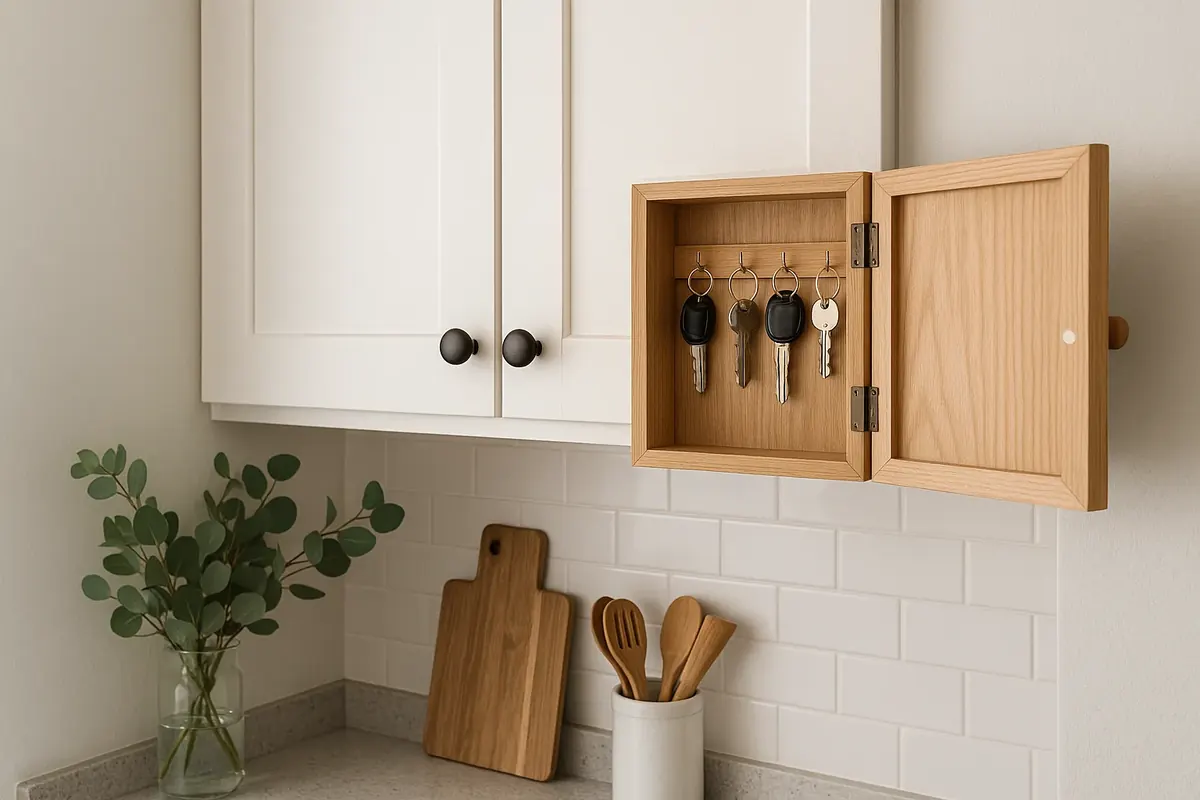
Keys, mail and sunglasses tend to land on the kitchen counter, especially in apartments where the kitchen is near the door. A small wall cabinet or a single drawer dedicated to them solves it. Our guide to building a hidden key cabinet shows how to make one that blends into the room.
- Measure each cabinet's interior width, depth and height before buying organizers.
- Group items by task: coffee, baking, cleaning, everyday dishes.
- Store the things you use daily between hip and shoulder height.
- Move rarely used appliances to the highest or least convenient cabinet.
- Leave about 10 percent of each cabinet empty so it stays easy to maintain.
Apartment Kitchen Decor: Styling Shelves, Counters and Walls
Apartment kitchen decor should feel like a continuation of your living space, especially in open layouts. Pull one or two colors from your living room into the kitchen through towels, a runner, or a piece of art.
Style open shelves in groups of three
Arrange shelf items in small groups with varied heights: a stack of plates, a tall carafe and a small bowl, for example. Leave a third of each shelf empty. Repeat a material (wood, white ceramic, glass) on every shelf so they relate to each other.
Hang art in the kitchen
A framed print above a stretch of counter, at the end of a galley, or leaning on an open shelf instantly makes the kitchen feel finished. Choose glass-fronted frames that wipe clean and keep art away from the area directly behind the stove.
Pick a palette
If you are allowed to paint, a warm white, soft greige, or muted green on the walls works with most existing cabinets. Use our room color palette generator to build a 60-30-10 scheme around a color you cannot change, such as your countertop or cabinet finish.
Add life
A pot of herbs on the windowsill, a small olive tree or trailing pothos on a high shelf, and a bowl of lemons or seasonal fruit all add color without clutter.
Apartment Kitchen Ideas by Layout
Every layout has one main problem to solve. Focus on that first.
| Layout | Main challenge | Best moves |
|---|---|---|
| One-wall kitchenette (studio) | Kitchen is always on display | Closed storage, matching canisters, a cabinet-color film, accent lamp, art on the end wall |
| Galley | Feels narrow and dark | Under-cabinet lights both sides, light runner, focal point at the end, clear aisle |
| L-shape | Dead corner, short counters | Lazy Susan in the corner, rolling cart as extra prep space, pendant over the open end |
| U-shape | Can feel closed in | Remove some upper doors for open display (with permission), keep one wall clear |
| Kitchen with peninsula | Counter becomes a dumping ground | Two or three stools that tuck fully under, one tray of essentials, pendant lighting |
In a studio, the kitchen shares the room with your bed and sofa, so it should be the quietest part of the space visually. See our studio apartment ideas for how to zone the whole room.
Add counter space without renovating
- A rolling cart with a butcher-block top (about 18 x 30 in.) adds prep space and storage, then rolls against a wall.
- An over-the-sink cutting board or a stovetop cover creates temporary prep space.
- A wall-mounted fold-down table works as both prep surface and breakfast spot in tiny kitchens.
- A narrow console (12 in. deep) on a nearby wall can hold a coffee station so the kettle and grinder leave the main counter.
Bigger Upgrades Worth Discussing With Your Landlord
Some changes need permission but can pay off for both of you. Landlords are often more open to improvements that make the unit easier to rent next time, especially if you offer to cover the cost or use a professional.
- A new faucet. A single-handle pull-down faucet in your chosen finish changes how the sink area looks and works. Keep the original.
- Light fixture swaps. A licensed electrician typically charges for an hour or two of labor for a straightforward fixture swap, depending on your area.
- Painting the cabinets. Some landlords agree if the result is neutral and professionally done.
- Replacing a worn countertop with a remnant. Rarely approved in rentals, but worth asking in long-term leases or condo rentals where the owner plans upgrades anyway.
Put any agreement in writing, including whether you need to restore the original at move-out.
Putting It All Together: A Weekend Plan
If you want a noticeable change fast, follow this order. It front-loads the cheapest, highest-impact work.
- Friday evening: Clear every counter, edit, and decide what goes back. Order hardware and under-cabinet lights.
- Saturday morning: Swap all bulbs to warm white, high-CRI LEDs. Install under-cabinet lighting.
- Saturday afternoon: Organize cabinet interiors with risers, bins and dividers. Decant dry goods.
- Sunday morning: Change the hardware. Put the originals in a labeled bag.
- Sunday afternoon: Style one tray, one shelf and one wall. Add a runner, towels and a plant.
Typical total spend for this plan is $250 to $700, depending on hardware and lighting choices. Live with it for a few weeks before tackling bigger changes like a backsplash or cabinet film; once the light and clutter are fixed, you may find you need less than you thought. For more ways to make a compact home work harder, browse our small apartment ideas.
Free interactive tool
Room Lighting Calculator: lumens and a layered lighting plan
Frequently Asked Questions
How can I make my apartment kitchen look better without renovating?
Clear the counters down to a few daily-use items grouped on a tray, switch to warm white LED bulbs, add plug-in under-cabinet lights, and replace the cabinet hardware with longer pulls in one finish. Add a washable runner, matching towels and a plant. These changes are reversible, typically cost a few hundred dollars, and make the biggest visible difference.
Can I put peel-and-stick backsplash in a rental kitchen?
Usually yes, but ask your landlord first and test a small piece for about a week before covering the whole wall. Clean the surface with a degreaser, avoid placing it directly behind a gas burner, and know that adhesive can lift paint on removal. Thicker matte or gel-type tiles look the most convincing.
How do you make a galley kitchen look bigger?
Keep the floor and aisle clear, use bright under-cabinet lighting on both runs, choose light or glossy backsplash surfaces, and create a focal point on the end wall such as art or a tall shelf. Keeping one side visually quieter than the other also stops a galley feeling like a corridor.
What color cabinets make a small kitchen look expensive?
Warm whites, soft greige, muted greens and deep navy or charcoal all read as high-end when paired with quality-looking hardware and good lighting. In a rental, removable matte cabinet film or landlord-approved paint can change the color. Repeat one metal finish on hardware and fixtures for a cohesive look.
How do I add counter space to a small apartment kitchen?
Use a rolling cart with a butcher-block top, an over-the-sink cutting board, a stovetop cover, or a wall-mounted fold-down table. Moving the coffee station to a narrow console nearby also frees the main counter. Choose pieces that roll or fold away when you are not cooking.

We research designer standards, measure real rooms and test every recommendation against apartment realities: tight footprints, lease rules and budgets. How we write our guides.