Bathroom Drawer Organizer Guide: How to Organize Vanity Drawers, Under the Sink and Toiletries
Measure once, organize for good. Find the right bathroom drawer organizer for every drawer, tame the space under the sink and keep counters hotel-clear.
Key takeaways
- Measure each drawer's interior width, depth and usable height before buying organizers.
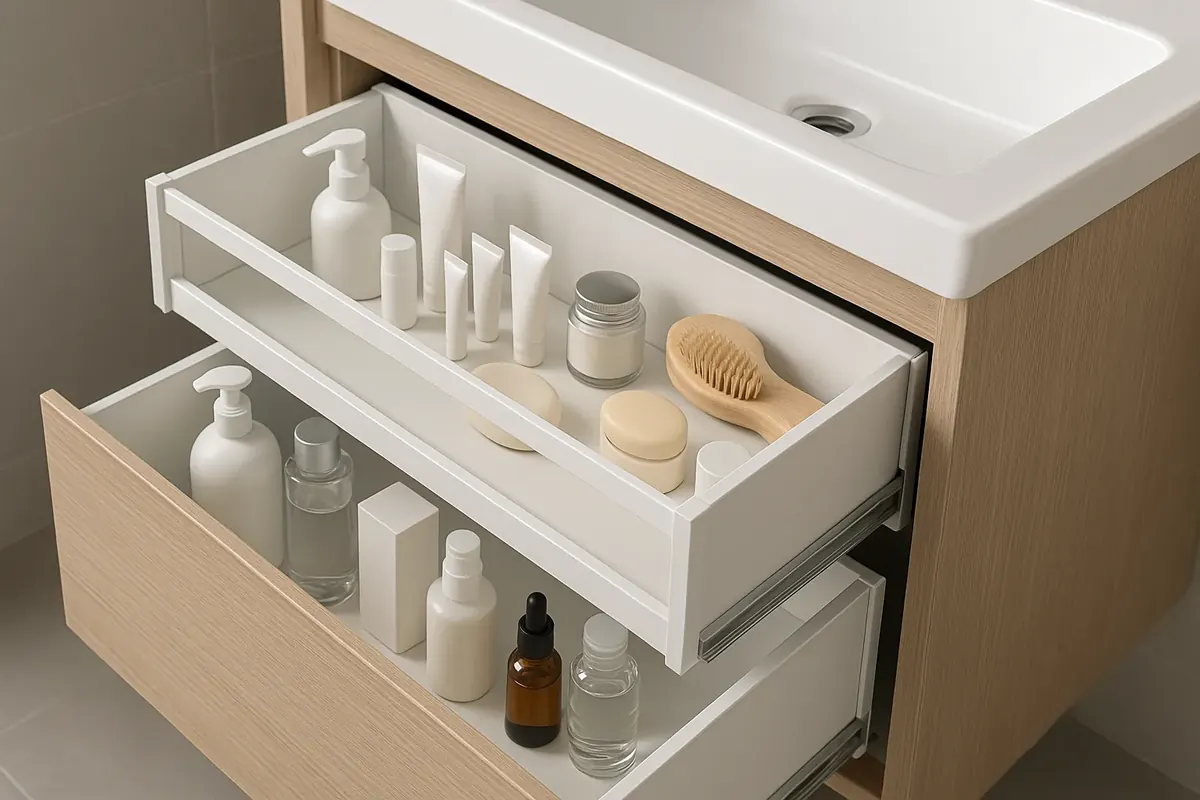
- Double layer sliding organizers suit drawers with at least 5 to 6 inches of usable height.
- Group toiletries by routine and keep daily items at the front of the top drawer.
- Use two-tier pull-outs on either side of the sink drain and keep shut-off valves accessible.
- Stick to one organizer material per drawer and decant products for a high-end look.
A good bathroom drawer organizer turns a deep, jumbled drawer into a set of clearly defined compartments where every product has a spot and you can see it at a glance. The most useful types are modular trays that you combine to fit your drawer exactly, and double layer drawer organizers with a sliding top tray that doubles the usable surface in deeper drawers. Pair them with an under-sink system and your vanity can hold far more than you think, while the counter stays clear.
This guide covers how to measure, which organizer types suit which drawers, how to lay out a vanity drawer by routine, under sink organization around awkward plumbing, and toiletry storage ideas that make a small rental bathroom feel like a hotel suite. Most of it costs $30 to $150 per vanity.
How to Measure for a Bathroom Drawer Organizer
The number one reason organizers fail is that they do not fit. Measure every drawer before you buy anything.
- Interior width: Measure side to side inside the drawer box, not the drawer front.
- Interior depth: Measure front to back inside the box. Many vanity drawers are 16 to 19 in. deep inside.
- Usable height: Measure from the drawer bottom to the underside of the counter or the frame above, minus about 1/4 in. so things do not catch when the drawer closes.
- Obstructions: Note any U-shaped cutouts for plumbing, slide hardware that intrudes inside, or a lip at the front.
- Your tallest item: Measure your tallest bottle that needs to stand upright in that drawer.
Write the measurements on a sketch of each drawer. When shopping, choose trays that fill the width and depth with no more than about 1/2 in. of slack in total, or the trays will slide around every time you open the drawer.
| Drawer type | Typical usable height | Best organizer |
|---|---|---|
| Shallow top drawer | 2.5–4 in. | Single-layer modular trays for makeup, razors, hair ties |
| Middle drawer | 5–7 in. | Double layer sliding organizer or deeper bins |
| Deep bottom drawer | 8–12 in. | Upright bins for bottles, hair tools, a stacked double layer |
| U-shaped drawer around plumbing | Varies | Narrow modular trays on each side of the cutout |
Types of Bathroom Drawer Organizers Compared
Each type suits a different drawer and a different routine. Prices are typical ranges by type, not specific products.
| Type | How it works | Best for | Typical price range |
|---|---|---|---|
| Modular trays | Separate rectangles you arrange like a puzzle | Custom fit in any drawer | $15–$40 per set |
| Double layer sliding organizer | Top tray slides on rails over a lower compartment | Drawers 5 in. or deeper | $25–$60 |
| Expandable dividers | Spring-loaded or adjustable strips that run front to back | Deep drawers with tall bottles | $15–$35 |
| Clear acrylic organizers | Transparent trays, often with lids or small drawers | Makeup and skincare you want to see | $20–$60 |
| Bamboo or wood inserts | Warm-toned trays and dividers | A spa or Japandi look | $20–$60 |
| Custom-cut inserts | Made to your measurements | Odd sizes, U-shaped drawers | $60–$200+ |
Materials: what holds up in a bathroom
Plastic and acrylic are waterproof and easy to wipe out, which makes them the most practical choice near the sink. Bamboo looks warmer and tolerates humidity better than most woods, but dry it if it gets wet. Avoid unsealed wood and fabric bins in drawers that get damp items. Add a washable silicone or cork liner underneath to catch spills and stop trays sliding.
How Double Layer Drawer Organizers Work
A double layer drawer organizer splits one deep drawer into two levels. The upper tray sits on rails or ledges and slides back to reveal a lower compartment. Some versions use two stacking trays instead of rails, where you lift the top one out.
When a double layer makes sense
- Your drawer has at least 5 to 6 in. of usable height.
- You have lots of small items you use daily (top layer) and backups or less frequent items (bottom layer).
- You share the vanity and want to split items by person: one layer each.
How to load it
Put your daily items, such as toothbrush case, skincare, deodorant and a hairbrush, in the top tray so you can grab them without moving anything. Use the lower level for refills, travel minis, first aid, nail tools and items you reach for weekly. Keep bottles that need to stand upright out of the double layer; they belong in a deeper drawer or under the sink.
Designer tip: Make sure the sliding top tray is no more than half the drawer's depth, or you will not be able to reach the lower level with the drawer only partly open.
Bathroom Vanity Drawer Organization by Routine
The fastest way to organize a vanity drawer is to group items by routine, then place each group by how often you use it. Front of the top drawer is prime real estate.
| Zone | What goes in it | Where to put it |
|---|---|---|
| Morning | Toothbrush, toothpaste, floss, skincare, deodorant | Front of top drawer or top layer |
| Grooming | Razors, tweezers, nail clippers, combs | Top drawer, small trays |
| Makeup | Daily makeup, brushes | Top or middle drawer, clear trays |
| Hair | Hair ties, clips, brushes, small tools | Middle drawer |
| Hot tools | Dryer, straightener, curling iron | Deep drawer or a heat-safe holder under the sink |
| Backups | Refills, unopened products | Lower layer or under the sink |
| First aid and meds | Bandages, ointment, thermometer | A labeled bin, ideally outside a steamy bathroom |
Medications are often better stored outside the bathroom, since heat and humidity can affect them; check the label for storage instructions.
Edit before you organize
Empty every drawer, toss expired and nearly empty products, and gather duplicates. Most people find they own several of the same item scattered across drawers. Our declutter checklist has a bathroom section that speeds this up.
Under Sink Organization Around Pipes
The cabinet under the sink is usually the largest storage space in a small bathroom, and the most wasted. The P-trap (the curved drain pipe) splits it in two, so standard shelves rarely fit.
Best under-sink solutions
- Two-tier pull-out organizers sit on either side of the drain. Look for ones about 10 to 12 in. wide each that slide out on runners.
- U-shaped or adjustable shelves wrap around the pipe with removable sections.
- Clear stacking bins with handles pull out like drawers and keep categories together: cleaning, hair care, backups.
- Door-mounted racks on the inside of the cabinet doors hold hair tools, a small trash bag roll or spray bottles. Check that they clear the pipe when the door closes.
- A tension rod mounted across the top of the cabinet holds spray bottles by their triggers.
Renter note: Keep the shut-off valves under the sink accessible so you or maintenance can reach them quickly in a leak. Place a waterproof tray or mat on the cabinet floor; it protects the base from drips and is something many landlords appreciate. Use adhesive hooks or tension rods instead of screws inside cabinets you do not own. Find more ideas in our list of renter friendly upgrades.
Toiletry Storage Ideas Beyond the Drawers
If your vanity has few drawers, or none, these toiletry storage ideas fill the gap.
- A tray on the counter: One stone, marble-look or wooden tray holding a soap pump and two or three daily products looks curated. Everything else goes away.
- Medicine cabinet organizers: Small acrylic risers and magnetic strips (for tweezers and clippers) double the space in a mirrored cabinet.
- A slim rolling cart: A narrow cart beside the toilet or vanity fits a 6 to 8 in. gap and holds backups.
- Over-the-toilet shelving: A freestanding unit uses dead wall space with no holes.
- Matching dispensers: Decanting shampoo, conditioner, body wash and hand soap into matching bottles transforms a cluttered shower or counter.
- Lidded jars: Glass apothecary jars for cotton pads, swabs and bath salts look elegant and keep things dry.
For layout ideas that start with the room itself, see our guide to small bathroom design.
How to Make Your Bathroom Storage Look High-End
Organized and beautiful are not always the same thing. A few choices make your bathroom drawers and counters feel like a boutique hotel.
- Stick to one material per drawer. All clear acrylic, all white, or all bamboo. Mixing colors and textures makes even a tidy drawer look busy.
- Decant whenever possible. Packaging is designed to stand out on a store shelf, which is exactly what you do not want at home.
- Use labels sparingly. Small, simple labels on bins under the sink are helpful; labels on every tray in a drawer are not needed.
- Edit the counter to three items or fewer. A soap pump, a small vase and a candle, for example.
- Choose rolled towels and a matching set. White or one soft neutral, stored rolled in a basket or on a shelf.
The most luxurious bathroom counter is the one with almost nothing on it.
These habits follow the same principles as quiet luxury interior design: fewer, better things, and plenty of breathing room.
Putting It All Together: Organize a Vanity in an Afternoon
- Empty every drawer and the under-sink cabinet onto a towel.
- Edit: toss expired products, combine duplicates, and relocate anything that does not belong in the bathroom.
- Measure each drawer's interior width, depth and usable height, plus the space around the pipe.
- Group items by routine: morning, grooming, makeup, hair, hot tools, backups.
- Buy organizers to fit: modular trays for shallow drawers, a double layer organizer for medium drawers, upright bins for deep ones, pull-outs under the sink.
- Line drawers with a washable liner, then load daily items at the front of the top drawer.
- Style the counter with one tray and no more than three items.
Expect to spend roughly $30 to $150 for a typical single vanity, depending on how many drawers you have and whether you choose acrylic, bamboo or custom inserts. Once it is done, a five-minute tidy every couple of weeks keeps it that way. For more ways to make every inch of a compact home count, browse our small apartment ideas.
Frequently Asked Questions
How do I organize a deep bathroom drawer?
Use a double layer sliding organizer to split the height into two levels, or stand bottles upright in bins and expandable dividers. Keep daily items on the top level or toward the front, and use the lower level for backups and weekly items. Measure the usable height first so nothing catches when the drawer closes.
What is the best bathroom drawer organizer material?
Plastic and clear acrylic are the most practical because they are waterproof and easy to wipe out. Bamboo looks warmer and handles humidity reasonably well if kept dry. Avoid unsealed wood and fabric in drawers that may get wet, and add a washable liner underneath.
How do you organize under a bathroom sink with pipes?
Use two-tier pull-out organizers about 10 to 12 inches wide on each side of the drain, or a U-shaped adjustable shelf that wraps around the pipe. Add clear bins with handles, door-mounted racks and a tension rod for spray bottles. Always keep the shut-off valves reachable.
How deep does a drawer need to be for a double layer organizer?
Most double layer drawer organizers need at least 5 to 6 inches of usable height to leave room for items on both levels. Measure from the drawer bottom to the frame above it and subtract about a quarter inch for clearance.
Where should I store toiletries in a small bathroom with no drawers?
Use a medicine cabinet with acrylic risers, an over-the-toilet shelving unit, a slim rolling cart beside the vanity, and a single tray on the counter for daily items. Decanting products into matching dispensers and lidded jars keeps open storage looking tidy.

We research designer standards, measure real rooms and test every recommendation against apartment realities: tight footprints, lease rules and budgets. How we write our guides.